Summary
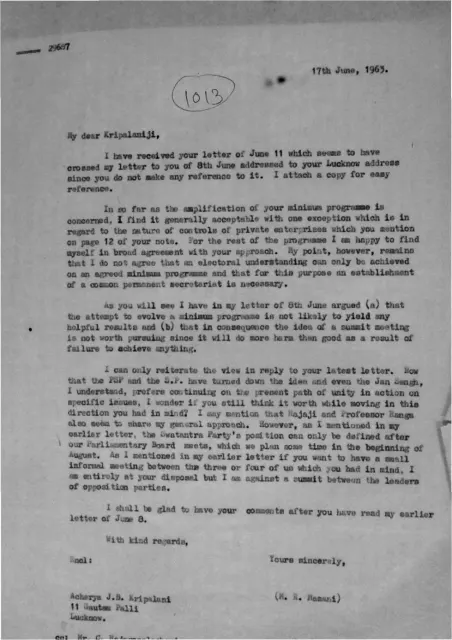
This one-page typed letter, dated 17th June 1963, is from Minoo Masani to Acharya J.B. Kripalani, replying to Kripalani’s letter of 11th June (which had crossed Masani’s own of 8th June). It is a tightly argued rejection of Kripalani’s proposal for a formal opposition compact built around an agreed minimum programme, a common permanent secretariat, and a summit meeting of opposition leaders.
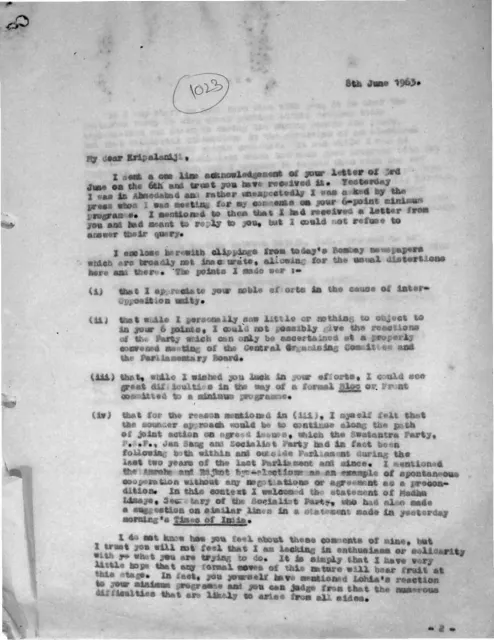
Masani signals broad agreement with Kripalani’s amplification of the minimum programme, registering only one reservation — the treatment on page 12 of Kripalani’s note of controls over private enterprise. What he refuses is the mechanism. He does not accept that an electoral understanding requires an agreed minimum programme or a permanent secretariat, and he restates the two propositions of his June 8 letter: that the attempt to hammer out a minimum programme is unlikely to bear fruit, and that a summit meeting, being liable to fail visibly, would do more harm than good.
He reports that the PSP, the Socialist Party and even the Jan Sangh have turned the idea down, and wonders whether Kripalani still thinks the path is worth pursuing. He notes that Rajaji and Professor Ranga share his approach, and that the Swatantra Party’s own position can only be settled once its Parliamentary Board meets in early August. He offers himself for a small, informal meeting of three or four, but is firm against any summit of opposition leaders, and asks for Kripalani’s comments once the earlier letter has been read.
Key points
- Masani replies to Kripalani’s 11 June letter, which had crossed his own of 8 June on the same subject of opposition unity.
- He accepts Kripalani’s amplified minimum programme in broad terms, dissenting only on the treatment of controls over private enterprise on page 12 of Kripalani’s note.
- He rejects the claim that an electoral understanding requires either an agreed minimum programme or a common permanent secretariat.
- He restates two propositions from June 8: the minimum-programme exercise is unlikely to yield useful results, and a summit meeting risks doing more harm than good.
- He notes that the PSP, the Socialist Party and the Jan Sangh have already turned the idea down.
- He reports that Rajaji and Professor Ranga share his general approach, while the Swatantra Party’s stance awaits its Parliamentary Board meeting in early August.
- He is open to a small informal meeting of three or four leaders but is against a summit between the leaders of the opposition parties.
Metadata and summary are AI-extracted from the source PDF and reviewed for editorial accuracy. The original work is available via the Read PDF tab above (where present); paragraph-level citation inside the PDF is deferred to a future engagement.