letter
Letter to Mr Minoo Masani
1963
2 pages
Summary
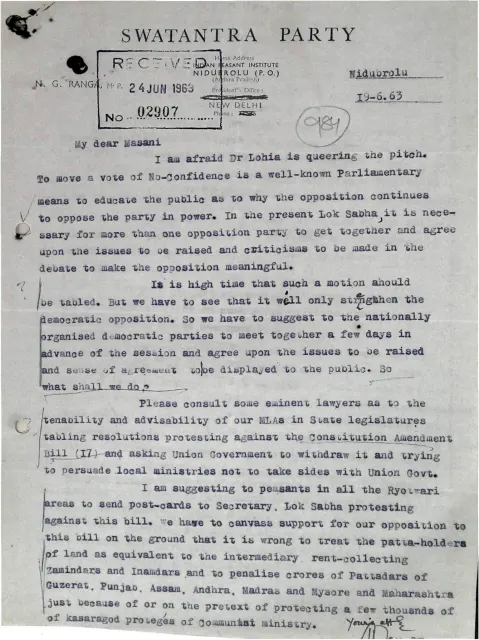
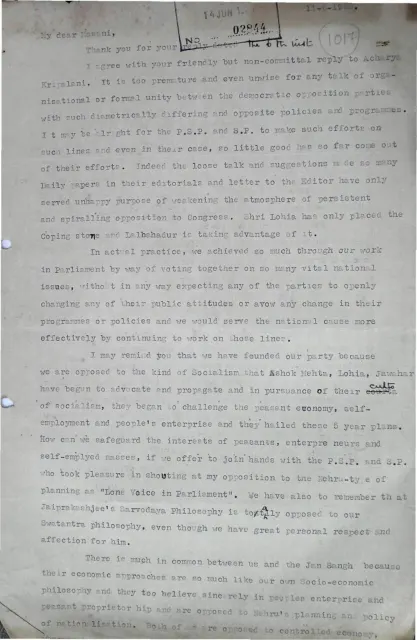
This June 1963 letter from a fellow Swatantra Party leader to Minoo Masani weighs in on Acharya Kripalani’s overtures for organisational unity among the democratic opposition parties. The writer endorses Masani’s “friendly but non-committal” reply, arguing it is premature and even unwise to talk of formal fusion with parties whose policies diametrically differ. He grants that voting together on national issues in Parliament has already delivered results, and insists the anti-Congress cause is better served by that pragmatic cooperation than by any merger that would blur programmatic identities. Lohia’s manoeuvring and the Prime Minister’s use of Lal Bahadur as a “coping stone” are treated as warnings of what happens when opposition energies are dissipated in loose talk.
The letter then restates the raison d’être of Swatantra: opposition to the socialism advocated by Ashok Mehta, Lohia and Jawaharlal Nehru, defence of the peasant economy, self-employment and “people’s enterprise”, and rejection of the Five-Year-Plan model of planning. Common economic ground with the Jan Sangh is acknowledged — both parties, the writer notes, back peasant proprietorship and oppose nationalisation — but the language question and the Pakistan issue are said to keep the two sides apart. Swatantra’s position as the single largest democratic opposition party (“nearly 50 per cent of all the organised Democratic opposition strength”) is offered as proof that its independent philosophy is best propagated through parliamentary work rather than dissolved in a united front.
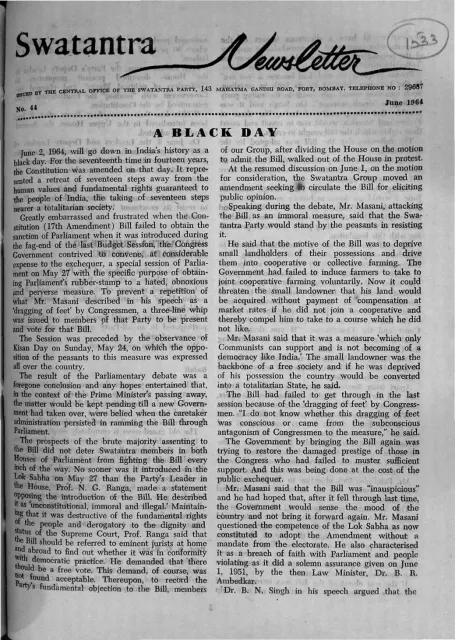
The closing section flags two urgent worries. First, the language agitation, “surcharged with emotions and irrational jingoistic momentum from the Northern States”, threatens the growing sense of unity within Swatantra itself. Second, the forthcoming Seventeenth Amendment to the Constitution — which the writer reads as an attempt to equate even the pettiest Ryotwari holding with the “Estate” of former Zamindars and Inamdars — is treated as an existential threat to peasant proprietorship across Madras, Andhra, Kerala, Mysore, Maharashtra, Punjab, Gujarat and Orissa. He calls for a nation-wide campaign from Kisan Sammelan and party platforms, and asks that Kripalani, the P.S.P. and the S.P. be drawn into a joint fight against the Bill.
Key points
- Endorses Masani’s non-committal reply to Acharya Kripalani’s unity proposal, calling formal fusion of ideologically opposed parties premature and unwise.
- Argues that voting together in Parliament on national issues has already served the opposition cause better than any merger could.
- Restates that Swatantra was founded specifically against the socialism advocated by Ashok Mehta, Lohia and Nehru, and against Nehru-type planning.
- Identifies economic common ground with the Jan Sangh on peasant proprietorship and opposition to nationalisation, but marks the language and Pakistan questions as unbridgeable differences with them.
- Cites Swatantra’s position as the single largest democratic opposition party — nearly 50 per cent of organised opposition strength — as reason to preserve its independent voice.
- Warns that the language agitation from the Northern States threatens the internal unity and comradeship of Swatantra itself.
- Reads the proposed Seventeenth Amendment as an attempt to equate petty Ryotwari holdings with the estates of former Zamindars and Inamdars, and calls for a nationwide Kisan Sammelan campaign against it.
- Proposes that Kripalani’s Praja Socialist Party and the Socialist Party be drawn into a joint fight with Swatantra against the Amendment Bill.
Metadata and summary are AI-extracted from the source PDF and reviewed for editorial accuracy. The original work is available via the Read PDF tab above (where present); paragraph-level citation inside the PDF is deferred to a future engagement.