Summary
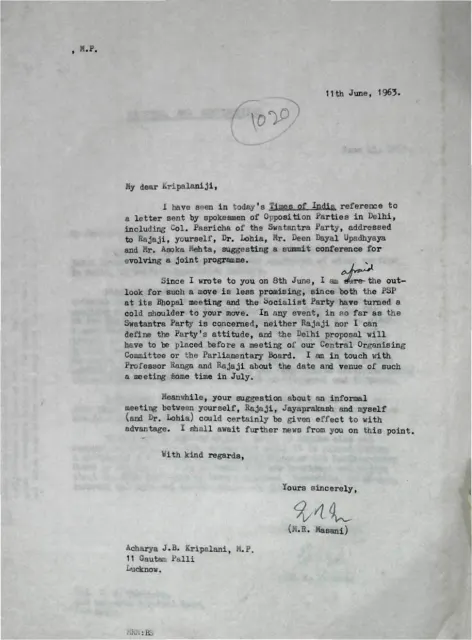
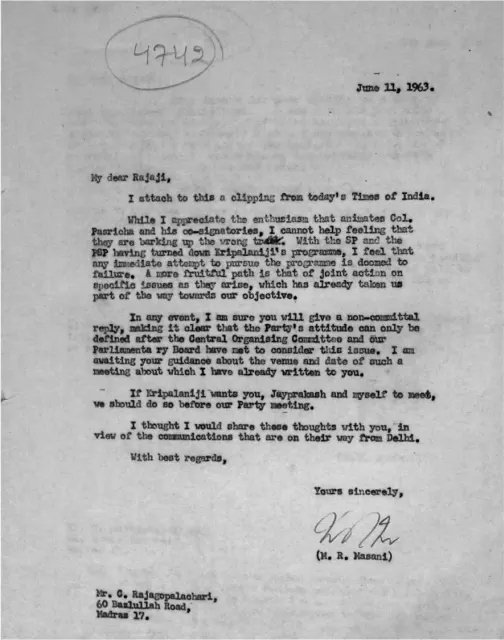
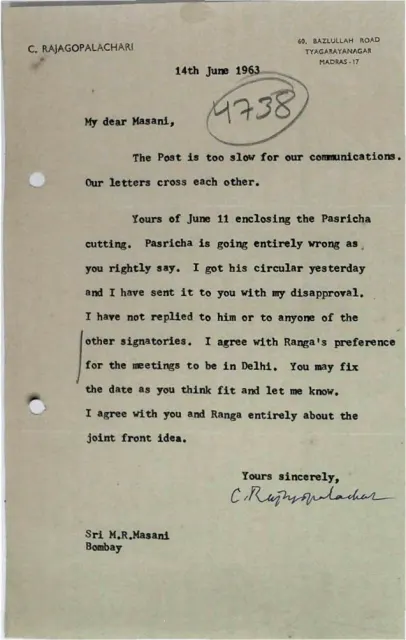
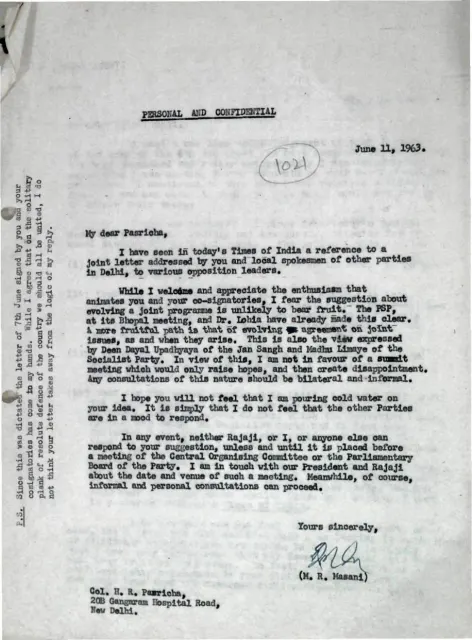
In this brief, personal-and-confidential letter of 11 June 1963, Minoo Masani writes to Col. H. R. Pasricha in New Delhi in response to a joint letter Pasricha and his co-signatories had addressed to spokesmen of the opposition parties in Delhi, a move reported that morning in the Times of India. Masani welcomes the enthusiasm behind the appeal but sets out sober political reasons why he cannot back the proposal for a joint programme of the opposition parties: the PSP at the Bhopal meeting, and Dr. Lohia, have already indicated they will not go along; Deen Dayal Upadhyaya of the Jan Sangh and Madhu Limaye of the Socialist Party have said the same. In Masani’s judgement, a summit-style consultation would raise hopes only to disappoint them, and any useful contact between opposition parties must therefore be bilateral and informal.
Masani insists he is not “pouring cold water” on Pasricha’s idea; he simply doubts the other parties are in a mood to respond. He undertakes to raise the question of a Swatantra reply with the Central Organising Committee or the Parliamentary Board, and promises to stay in touch with the party’s President and with Rajaji about a date and venue for such a meeting, while continuing informal and personal consultations in the meantime. A holograph postscript, added after dictation, notes that Pasricha’s follow-up letter of 7 June has since arrived: Masani concedes that on the solitary plank of resolute defence of the country the opposition should be united, but does not think that concession disturbs the logic of his reply.
Key points
- Written on Swatantra Party letterhead-era stationery by M. R. (Minoo) Masani to Col. H. R. Pasricha, 20B Gangaram Hospital Road, New Delhi, and marked ‘Personal and Confidential’.
- The trigger is a joint letter, publicised in the Times of India, that Pasricha and co-signatories had sent to local spokesmen of the opposition parties in Delhi calling for a joint programme.
- Masani reads the political weather as unfavourable: the PSP (at Bhopal) and Dr. Lohia have already spoken against the joint-programme idea, and Deen Dayal Upadhyaya of the Jan Sangh and Madhu Limaye of the Socialist Party have taken the same view.
- He argues against any ‘summit meeting’ as a device that would only raise hopes and end in disappointment, and prefers bilateral, informal contacts as the working method between opposition parties.
- He undertakes to place Pasricha’s suggestion before the Central Organising Committee or the Parliamentary Board of the Swatantra Party, and to consult the party’s President and Rajaji about the date and venue.
- A handwritten postscript acknowledges Pasricha’s letter of 7 June and concedes unity on the ‘solitary plank of resolute defence of the country’, while maintaining the substantive argument of the reply.
- The letter is a compact window into Swatantra’s stance in the immediate aftermath of the 1962 Sino-Indian war, when calls for opposition unity were in the air.
Metadata and summary are AI-extracted from the source PDF and reviewed for editorial accuracy. The original work is available via the Read PDF tab above (where present); paragraph-level citation inside the PDF is deferred to a future engagement.