letter
Letter to Kripalani
By Minoo Masani
Swatantra Party, Central Office, Sassoon Building, 143 Mahatma Gandhi Road, Bombay 1 · Bombay · 1963
6 pages
Summary
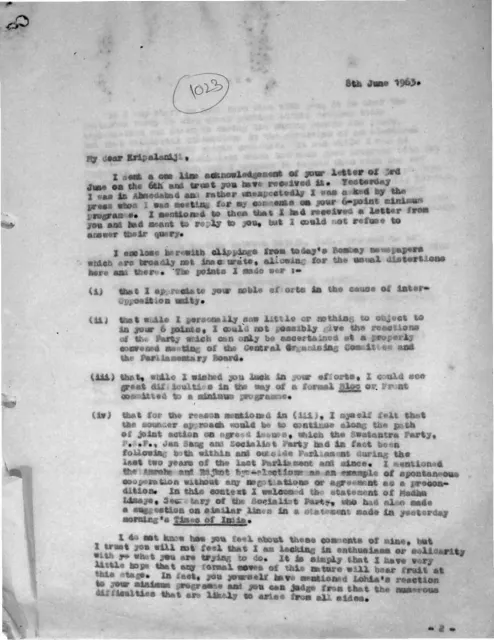
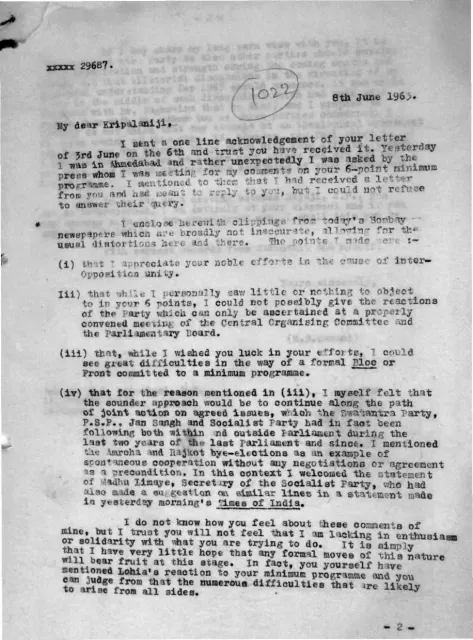
Writing from the Swatantra Party central office in Bombay on 8 June 1963, Minoo Masani responds to Acharya J. B. Kripalani’s letter of 3 June about a six-point minimum programme for Opposition unity. Masani reports that he had already been buttonholed by the Bombay press in Ahmedabad and had, reluctantly, given a four-point public reply — which he encloses as clippings — while making clear that any authoritative party position could only come from a properly convened meeting of the Swatantra Central Organising Committee and Parliamentary Board.
He uses the letter to draw a sharper personal line. Though he appreciates Kripalani’s efforts and personally finds little to object to in the six points, he sees “great difficulties” in the way of a formal Opposition Bloc or Front bound to a minimum programme, and does not believe that an attempt at ideological agreement is worth making at this time. The sounder path, in his view, is what the Swatantra Party, the PSP, the Jan Sangh and the Socialist Party have already been doing inside and outside Parliament for the past two years — joint action on agreed issues, without any negotiated agreement as a precondition — and he cites the Amroha and Rajkot by-elections as examples, welcoming a similar-toned statement by Madhu Limaye in that morning’s Times of India.
Masani then discloses his own long-term strategy: each opposition party should keep building its own organisation, but bilateral discussions aimed at an electoral understanding for 1967 should begin. He notes that such discussions with Dr. Raghuvira had been well advanced when Raghuvira died, and that he proposes to resume them with the two or three other parties. If Kripalani nonetheless wishes to continue his own effort, Masani says he is welcome to do so — Masani will “sit back” and let others show the same enthusiasm for unity. He closes by placing himself entirely at Kripalani’s disposal for a meeting with Rajaji and J.P. anywhere in India, and sends warm regards from his wife Sakuntala.
Key points
- Letter from Minoo Masani, on Swatantra Party letterhead (Sassoon Building, Bombay), to Acharya J. B. Kripalani M.P. in Lucknow, dated 8 June 1963.
- Written in response to Kripalani’s letter of 3 June about a six-point minimum programme for Opposition unity, on which Masani had been pressed for comment by the Bombay press in Ahmedabad.
- Masani sets out four public points: appreciation of Kripalani’s efforts, inability to speak for the Swatantra Party without a properly convened meeting of its Central Organising Committee and Parliamentary Board, doubt about a formal Bloc or Front tied to a minimum programme, and preference for continuing joint action on agreed issues.
- He cites the record of the Swatantra Party, PSP, Jan Sangh and Socialist Party inside and outside Parliament over the last two years, and the Amroha and Rajkot bye-elections, as models of “spontaneous cooperation without any negotiations or agreement as a precondition”.
- He welcomes a statement by Madhu Limaye, Secretary of the Socialist Party, in the Times of India of the previous morning, as consistent with this approach, and refers to Ram Manohar Lohia’s less friendly reaction to Kripalani’s programme.
- Long-term view: opposition parties should keep building their own organisation and strength, but bilateral talks aimed at an electoral understanding for 1967 should begin — resuming the discussions with Dr. Raghuvira interrupted by his death.
- Masani states plainly that he does not think an attempt at ideological agreement across the Opposition is worth making at this time.
- He offers to meet Kripalani together with Rajaji and Jayaprakash Narayan (J.P.) anywhere in India, and closes with regards from Sakuntala Masani.
Metadata and summary are AI-extracted from the source PDF and reviewed for editorial accuracy. The original work is available via the Read PDF tab above (where present); paragraph-level citation inside the PDF is deferred to a future engagement.