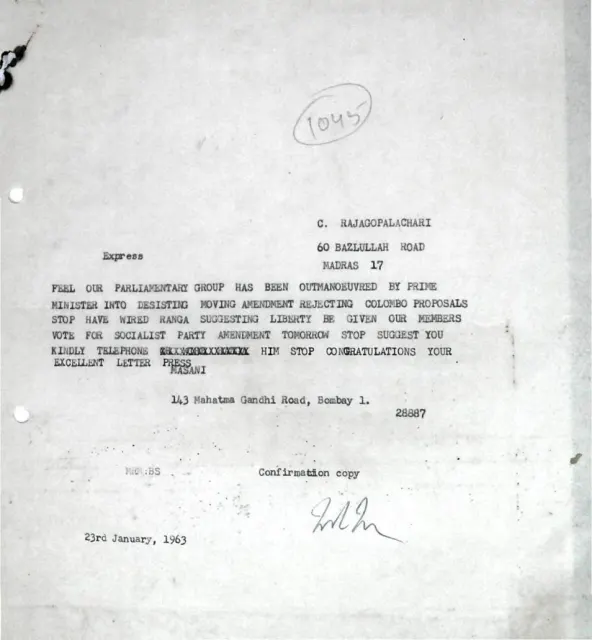
telegram
Telegram to NG Ranga
By Minoo Masani
Swatantra Party Central Office, 143, Mahatma Gandhi Road, Bombay 1. · Bombay · 1963
1 pages
Summary
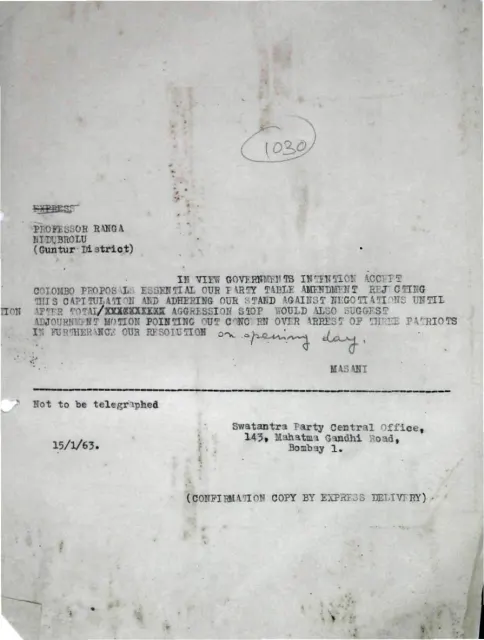
A one-page express telegram dated 15 January 1963 from Minoo Masani, at the Swatantra Party Central Office on Mahatma Gandhi Road, Bombay, to Professor N. G. Ranga at Nidubrolu in Guntur District. Masani urges Ranga to have the party table a parliamentary amendment rejecting the Government of India’s apparent intention to accept the Colombo Proposals for a Sino-Indian settlement, which Masani frames as a capitulation. He restates Swatantra’s line that there should be no negotiations with China until after total Chinese aggression has ceased.
Masani also proposes moving an adjournment motion on the opening day of the session to register concern over the arrest of three unnamed ‘patriots’, in furtherance of a Swatantra resolution already on the subject. A handwritten ‘on opening day’ clarifies the timing of the adjournment motion. The telegram is stamped ‘Not to be telegraphed’ with a note that a confirmation copy is being sent by express delivery, indicating it was intended as a hand-delivered instruction rather than a wired message.
Key points
- Telegram from Masani (Swatantra Party Central Office, Bombay) to Prof. N. G. Ranga at Nidubrolu, Guntur District, dated 15 January 1963.
- Reacts to the Government of India’s reported intention to accept the Colombo Proposals for settlement of the Sino-Indian border conflict.
- Directs Ranga to have Swatantra table a parliamentary amendment rejecting acceptance, described as a ‘capitulation’.
- Reaffirms the party’s stand that no negotiations with China should be entered into until ‘total aggression’ has stopped.
- Proposes an adjournment motion, added by hand ‘on opening day’, concerning the arrest of three patriots, tied to an existing Swatantra resolution.
- Marked ‘Not to be telegraphed’ with a confirmation copy sent by express delivery, indicating the item was routed as a hand-delivered dispatch rather than a wired telegram.
Metadata and summary are AI-extracted from the source PDF and reviewed for editorial accuracy. The original work is available via the Read PDF tab above (where present); paragraph-level citation inside the PDF is deferred to a future engagement.