essay
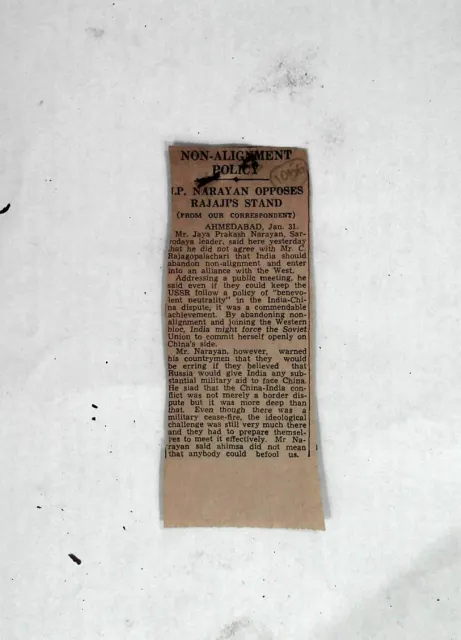
Non-Alignment Policy
J.P. Narayan Opposes Rajaji's Stand
2 pages
Summary
This short newspaper clipping, filed from Ahmedabad on January 31 by an unnamed correspondent, reports Jayaprakash Narayan’s public rejection of C. Rajagopalachari’s call for India to abandon non-alignment and enter an alliance with the West in the aftermath of the India-China conflict. Addressing a public meeting, Narayan argued that even a Soviet posture of ‘benevolent neutrality’ in the India-China dispute would count as a commendable achievement for Indian diplomacy, and that abandoning non-alignment for the Western bloc could push Moscow into openly siding with Peking.
At the same time, Narayan cautioned Indians against complacency: he did not believe that Russia would supply substantial military aid to help India face China, and he insisted that the China-India conflict was ‘more deep’ than a border dispute. Despite the military cease-fire, the ideological challenge from China persisted and had to be met. He closed with the aphorism that ahimsa did not mean ‘anybody could befool us’ — a rebuttal to the charge that non-alignment amounted to naivety.
Key points
- Jayaprakash Narayan publicly opposes C. Rajagopalachari’s proposal that India abandon non-alignment and ally with the West.
- Narayan argues that keeping the USSR to a stance of ‘benevolent neutrality’ in the India-China dispute is itself a diplomatic achievement worth preserving.
- He warns that switching to the Western bloc could push the Soviet Union to declare openly for China.
- He tempers Indian expectations, doubting that Russia would give India any substantial military aid against China.
- He frames the India-China conflict as ideological and enduring, not merely a border dispute, so preparation must continue even after the cease-fire.
- He defends ahimsa against the charge of naivety, insisting it does not license anyone to ‘befool’ India.
Metadata and summary are AI-extracted from the source PDF and reviewed for editorial accuracy. The original work is available via the Read PDF tab above (where present); paragraph-level citation inside the PDF is deferred to a future engagement.