Summary
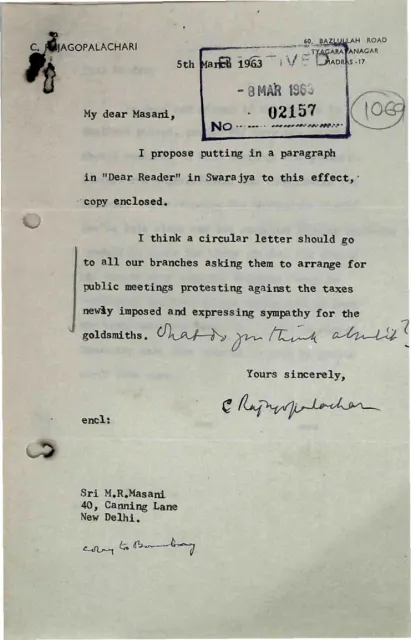
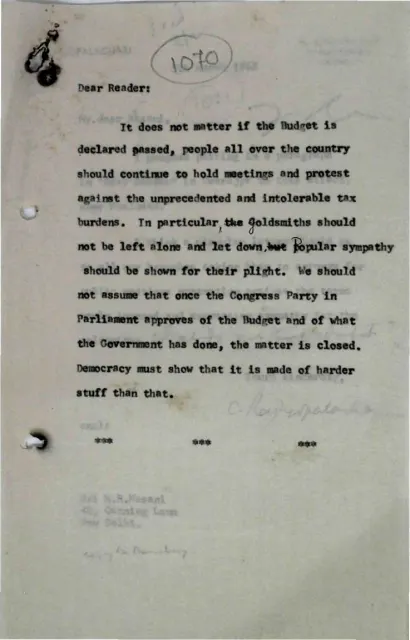
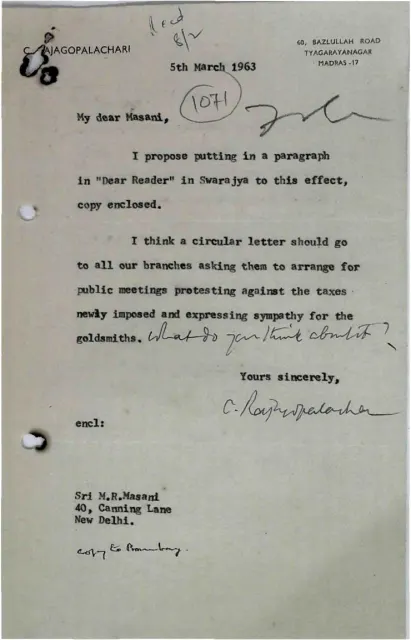
This one-page letter, dated 5th March 1963, is sent by C. Rajagopalachari from his Bazlullah Road address in Tyagarayanagar, Madras, to Minoo Masani at 40 Canning Lane, New Delhi, with a copy directed to Bombay. Rajagopalachari tells Masani that he proposes to insert a paragraph in the ‘Dear Reader’ column of Swarajya to a stated effect, a copy of which is enclosed.
He then suggests that a circular letter should go out to all branches — implicitly of the Swatantra Party — asking them to organise public meetings that would protest against the newly imposed taxes and express sympathy for the goldsmiths, a reference to the agitation triggered by the Gold Control regime of early 1963. A handwritten annotation in the margin, apparently by Masani or a member of his office, asks ‘What do you think about it?’, turning the note into an item for consultation before the circular goes out.
Key points
- Private letter from C. Rajagopalachari (Madras) to Minoo Masani (New Delhi), dated 5 March 1963, with a copy marked to Bombay.
- Rajagopalachari announces he will place a paragraph in the ‘Dear Reader’ column of Swarajya on the matter at hand, a copy enclosed with the letter.
- He proposes that a circular letter be sent to all branches asking them to organise public meetings.
- The meetings are to protest the newly imposed taxes and to express sympathy for the goldsmiths — a clear reference to opposition to the 1963 Gold Control measures.
- The letter treats organised public agitation and the Swarajya editorial as complementary instruments in a single campaign.
- A handwritten marginal note (‘What do you think about it?’) indicates the proposal was being circulated for consultation before action.
Metadata and summary are AI-extracted from the source PDF and reviewed for editorial accuracy. The original work is available via the Read PDF tab above (where present); paragraph-level citation inside the PDF is deferred to a future engagement.