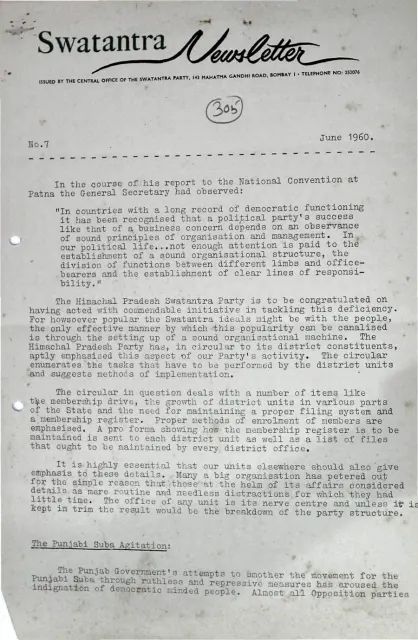
periodical issue
Swatantra Newsletter
ISSUED BY THE CENTRAL OFFICE OF THE SWATANTRA PARTY, 143 MAHATMA GANDHI ROAD, BOMBAY 1 · TELEPHONE NO: 252076 · Bombay · 1960
12 pages
Summary
Issue No. 7 (June 1960) of the Swatantra Newsletter, put out by the Central Office of the Swatantra Party at 143 Mahatma Gandhi Road, Bombay, is an internal bulletin of party news, statements and state-branch reports written six months after the Party’s founding Patna Convention. It opens with the General Secretary’s warning that a political party’s success, like a business concern’s, depends on “sound principles of organisation and management,” and praises the Himachal Pradesh unit’s circular on membership drives, district files and pro-forma registers as a model for other state units.
The political sections cover the Party’s most active fronts of the month: outrage at the Kairon government’s handling of the Punjabi Suba agitation (including the Karnal Murder Case, in which K. M. Munshi successfully appealed the acquittal of eleven police officers), Murarji Vaidya’s reply to Raja Hutheesing’s resignation and to Congress critics who read the Party as pro-laissez-faire, M. R. Masani’s statement on the University Grants Commission report on student indiscipline, and N. G. Ranga’s Hyderabad ultimatum to Congressmen opposed to joint farming to “make up their minds” about staying in the Congress.
Roughly half the issue is a state-by-state report on organisational build-up in Andhra, Assam, Bihar, Bombay, Delhi, Kerala, Madhya Pradesh, Maharashtra, Mysore, Punjab, Uttar Pradesh and West Bengal — Constituency Committees being set up, membership drives launched, jeeps allocated, study circles convened, and the “To Prosperity through Freedom” Statement of Policy being translated into Telugu, Urdu, Kannada, Tamil, Punjabi and Hindi for wider distribution. The West Bengal committee resolution closes the issue with the Party’s clearest self-definition of the month: pledged to “Individual Freedom and the upholding of Dharma,” against regimentation, and offering an alternative to a Congress socialism it calls “a delusion and a snare.”
Key points
- The General Secretary’s Patna Convention report is quoted urging Swatantra units to adopt business-like organisational discipline — filing systems, membership registers, district-level pro formas — following the Himachal Pradesh unit’s example.
- The Punjabi Suba agitation and the Karnal Murder Case dominate the political coverage: the Party attacks the Kairon Ministry as dictatorial, and K. M. Munshi wins an appeal reinstating the murder charges against eleven Punjab police officers.
- Chairman Murarji Vaidya of the Bombay Party rebuts Raja Hutheesing’s resignation statement, arguing Hutheesing’s socialism would produce “economic chaos” and quoting Chapter Four of the Statement of Policy to show the Party stands neither for laissez-faire nor for state exploitation.
- M. R. Masani, as General Secretary, issues a statement backing the University Grants Commission’s call for parties to keep out of college campuses and writes to UGC chairman C. D. Deshmukh reiterating the Swatantra Party’s self-denying ordinance on student politics.
- State-branch reports show a Party in rapid build-out — Constituency Committees, jeep-based propaganda tours, and translations of the “To Prosperity through Freedom” Statement of Policy into Telugu, Urdu, Kannada, Tamil, Punjabi and Hindi.
- Masani, addressing a public meeting at Secunderabad, predicts the Swatantra Party will form the largest opposition bloc after the 1962 general elections and be able to offer an alternative government by 1967.
- The West Bengal committee’s resolution frames the Party as pledged to “Individual Freedom and the upholding of Dharma,” against regimentation, and as an alternative democratic vehicle where “Conservatives and Radicals can work together.”
- Legislators and MPs of the Bihar Party resolve to contribute 10% and 20% of their salaries respectively to the Party Fund from May 1960, and Mysore members debate the decision not to contest Panchayat and Taluk Board elections before 1962.
Metadata and summary are AI-extracted from the source PDF and reviewed for editorial accuracy. The original work is available via the Read PDF tab above (where present); paragraph-level citation inside the PDF is deferred to a future engagement.