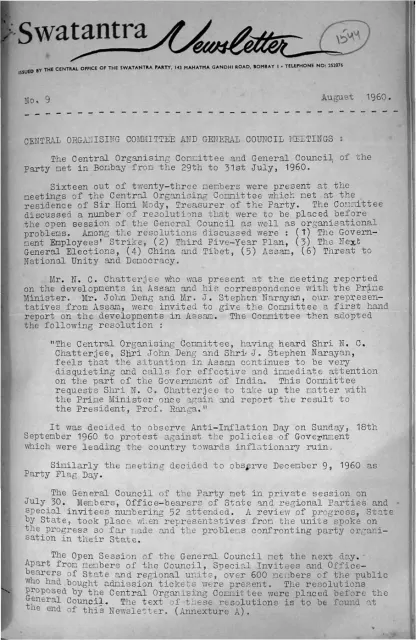
periodical issue
Swatantra Newsletter
ISSUED BY THE CENTRAL OFFICE OF THE SWATANTRA PARTY, 143 MAHATMA GANDHI ROAD, BOMBAY 1 - TELEPHONE NO: 352076 · Bombay · 1960
15 pages
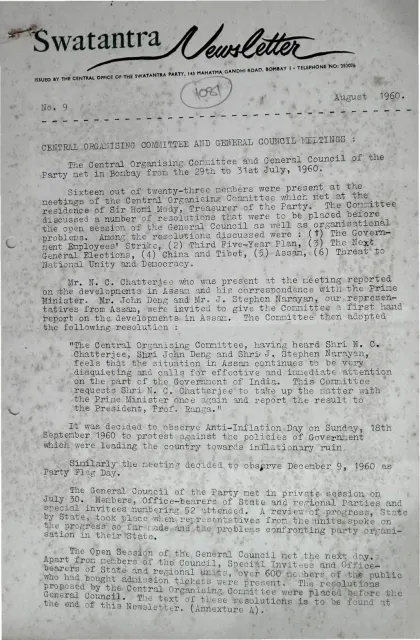
Summary
Issue No. 9 of the Swatantra Newsletter, dated August 1960 and issued from the Party’s Central Office at 143 Mahatma Gandhi Road, Bombay, is a fifteen-page in-house bulletin reporting on the Party’s Central Organising Committee and General Council meetings held in Bombay from 29-31 July 1960. It opens with a summary of committee deliberations — attended by sixteen of twenty-three members at Sir Homi Mody’s residence — that covered six flagship resolutions on the Government Employees’ Strike, the Third Five-Year Plan, the next General Elections, China and Tibet, Assam, and the Threat to National Unity and Democracy. It records the decision to observe 18 September 1960 as “Anti-Inflation Day” and 9 December 1960 as “Party Flag Day,” and notes that C. Rajagopalachari addressed both the private General Council session and a public meeting of over 20,000 at Chowpatty despite inclement weather.
The bulk of the newsletter is a state-by-state field report from thirteen state units — Andhra, Assam, Bihar, Bombay, Himachal Pradesh, Madras, Maharashtra, Mysore, Orissa, Punjab, Uttar Pradesh, and West Bengal — cataloguing membership drives, district conventions, purse presentations, and the tours of Prof. N. G. Ranga (Party President) and Prof. M. Ruthnaswamy (Vice-President). Recurring motifs are organisational scale (Bihar claiming a membership approaching a lakh, Coimbatore over 20,000, Punjab organised in seventeen of eighteen districts), Congress-Government harassment of Party workers (especially in Chingleput and Punjab), and the invocation of Rajaji’s rhetoric that the Government is “after all only a paper tiger.”
The closing third of the issue reproduces “Annexure A” — the full text of seven resolutions adopted at the Open Session of 31 July 1960. These articulate the Party’s core positions in the second year of its life: opposition to the Central Government employees’ strike but sympathy for its economic causes; condemnation of “periodic repression” in Punjab, with a fact-finding team of K. M. Munshi, N. C. Chatterjee, Sardar Kartar Singh Campbellpuri and C. B. Agarwala dispatched to investigate; the constitution of a panel led by B. R. Shenoy to examine the draft Third Five-Year Plan within two months; a call on state units to complete member enrolment and prepare parliamentary candidate panels by February 1961; a tribute to the Tibetan people’s resistance to Chinese occupation; and a diagnosis that Congress policies are producing “parochial chauvinism” and disintegrating national unity.
Key points
- Central Organising Committee and General Council of the Swatantra Party met in Bombay from 29-31 July 1960, with the Open Session drawing over 600 members of the public who had bought admission tickets.
- The Party fixed 18 September 1960 as “Anti-Inflation Day” and 9 December 1960 as “Party Flag Day,” instructing state units to distribute leaflets “on the evils of inflation” and fix responsibility on the Government for the rising cost of living.
- Rajaji, arriving in Bombay on 28 July, was received by a Volunteer Corps guard of honour at the airport, addressed a Rs. 100-per-plate dinner of 350 party donors on 29 July, spoke to more than 20,000 people at Chowpatty despite inclement weather, and visited the Dharavi slum promising the Swatantra Party would not demolish the huts of the poor.
- State reports detail rapid organisational build-up — Bihar with a membership approaching a lakh across seventeen districts and 280 thanas, Coimbatore alone with over 20,000 members contributing Rs. 20,000 to Party funds, Punjab organised in 17 of 18 districts, and Uttar Pradesh with over a lakh and 25 MLAs recognised as the Assembly’s opposition group.
- The Punjab report describes the state as almost continuously under Section 144 Cr.P.C., prohibiting conferences and meetings; the resolution on “Repression in the Punjab” was prompted by a telegram from Sardar Harbans Singh Gujral about the arrest of two Ludhiana lawyers defending Punjabi Suba detenus.
- A panel comprising B. R. Shenoy, Sardar Lal Singh, M. A. Sreenivasan, M. Ruthnaswamy and J. M. Lobo Prabhu was appointed to examine the Government’s draft Third Five-Year Plan and report within two months.
- The General Council’s resolution on the Government Employees’ Strike attacks “the reckless resort to deficit finance” and excise duties on necessities as the true drivers of the “vicious spiral of rising costs and wages,” and frames the strike as vindicating the Party’s thesis that “State Capitalism and Free Trade Unionism cannot co-exist for long.”
- M. R. Masani, the Party’s General Secretary, formally opened the new West Bengal office in Calcutta on 6 August 1960; the West Bengal Committee under N. C. Chatterjee had earlier adopted a resolution calling for a peaceful state-wide Hartal over the Assam crisis and demanding intervention by the Centre under Article 356.
Metadata and summary are AI-extracted from the source PDF and reviewed for editorial accuracy. The original work is available via the Read PDF tab above (where present); paragraph-level citation inside the PDF is deferred to a future engagement.