periodical issue
Swatantra Newsletter
Issued by the National Headquarters of the Swatantra Party, 143 Mahatma Gandhi Road, Bombay, Telephone No: 251424 · Bombay · 1970
14 pages
Summary
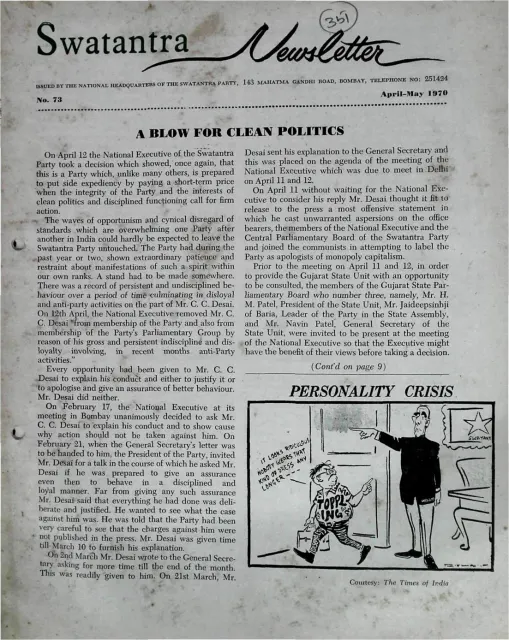
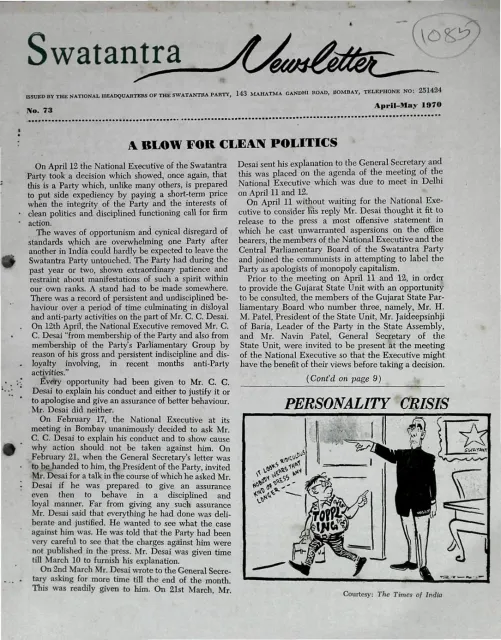
Issue No. 73 of the Swatantra Newsletter (April–May 1970), circulated privately from the Party’s National Headquarters at 143 Mahatma Gandhi Road, Bombay, is dominated by a single institutional decision and its aftermath: on 20 April the National Executive removed Mr. C. C. Desai from Party membership and from the Parliamentary Group for what the resolution calls ‘gross and persistent indiscipline and dis-loyalty involving, in recent months, anti-Party activities.’ The front-page editorial ‘A Blow for Clean Politics’ walks the reader through the sequence — the February 17 request for an explanation, Desai’s repeated extensions, his eventual pre-emptive statement to the press attacking office bearers, and the Executive’s decision to act on 12 April — and reproduces reactions from The Hindustan Times, The Statesman, Madras Mail, Himmat, Commerce, Indian Monitor, Political and Economic Review, Current and March of the Nation, most of which read the expulsion as a rare instance of an all-India party enforcing discipline against political expediency. R. K. Laxman’s ‘Personality Crisis’ cartoon (courtesy The Times of India) is carried as visual counterpoint.
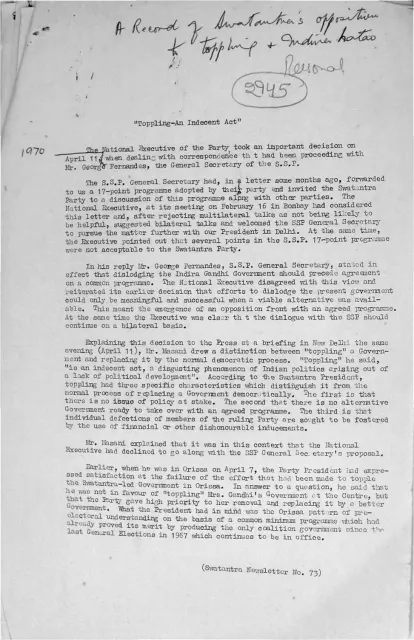
The political frame for the expulsion is Party President M. R. Masani’s public repudiation of ‘toppling’ as a method of politics. Speaking in Delhi on 11 April and again in Orissa in early April, Masani drew a sharp line between the constitutional replacement of a government and the buying or inducing of defections to bring one down, calling toppling ‘an indecent act, a disgusting phenomenon of Indian politics arising out of a lack of political development.’ The Newsletter uses this framing to justify Swatantra’s refusal to join a common programme with the SSP for dislodging the Indira Gandhi government except on terms of an agreed alternative, and to explain the Party’s satisfaction with the Swatantra-led coalition in Orissa, which had survived a ‘toppling’ attempt led by Congress and the PSP.
Alongside these two set-pieces the issue records the routine business of a mid-life opposition party: the National Executive’s Delhi meeting of 11–12 April (which mourned Bhailalbhai Patel — ‘Bhaikaka’ — and reviewed draft position papers on transport, communication, unemployment and agriculture); a Central Parliamentary Board meeting on Lok Sabha by-election arrangements, biennial Rajya Sabha results (Dahyabhai V. Patel, B. K. Deo and S. S. Mariswamy re-elected), and Assembly by-election nominations; a ‘Focus on Orissa’ round-up defending the coalition; and ‘Around the State Legislatures’ notes from Gujarat (H. M. Patel on the famine in Banaskantha, Law and Order, crop insurance) and Tamil Nadu (Dr. H. V. Hande on land ceilings, the Budget, bus services, and press freedom). ‘News from State Units’ collects branch activity from Andhra, Bombay (with a Delhi Convention that denounced attempts to curtail Fundamental Rights and Nath Pai’s Bill), Kerala, Mysore, Rajasthan, Tamil Nadu, and a Varanasi item on the BHU Vice-Chancellor’s disciplinary case.
The issue closes with a letter ‘From the General Secretary’s Desk’ by R. E. Cooper announcing 24 May as ‘Anti-Naxalite Activities Day,’ framing Naxalism as ‘merely Communism in a virulent form’ that threatens the country’s liberties, and reprinting a Financial Express editorial of 24 April. An Annexure reproduces the full text of the National Executive’s 12 April decision on Desai, itemising six charges of indiscipline ranging from his July 1969 support for V. V. Giri, his August 1969 press statement asking Swatantra MLAs to vote for the Congress candidate in the Gujarat Chief Minister ballot, and a February 1970 directive that the Party in Gujarat should side with any Government supported by Mrs. Gandhi’s followers.
Key points
- The National Executive expelled C. C. Desai from Swatantra Party membership and its Parliamentary Group on 20 April 1970 for ‘gross and persistent indiscipline and disloyalty,’ after he pre-emptively released a press statement on 11 April.
- President M. R. Masani framed ‘toppling’ — replacing a government by inducements rather than an agreed alternative programme — as ‘an indecent act, a disgusting phenomenon of Indian politics arising out of a lack of political development,’ and used this to explain Swatantra’s refusal to join the SSP’s move against Indira Gandhi.
- The Newsletter compiles nine press reactions to the Desai expulsion (Hindustan Times, Statesman, Madras Mail, Himmat, Commerce, Indian Monitor, Political and Economic Review, Current, March of the Nation), treating the near-unanimous approval as vindication of the Party’s stand for ‘cleaner politics.’
- The National Executive (Delhi, 11–12 April) mourned Bhailalbhai Patel (‘Bhaikaka’), adopted Piloo Mody’s ‘Towards a Better Life’ as the basis for a minimum-programme dialogue with democratic opposition parties, and circulated draft position papers on transport, unemployment and agriculture.
- The Central Parliamentary Board reported three re-elections to the Rajya Sabha (Dahyabhai V. Patel–Gujarat, B. K. Deo–Orissa, S. S. Mariswamy–Tamil Nadu) and disapproved Rattankumar Kattemar’s independent candidacy in Mysore after being asked to withdraw.
- ‘Focus on Orissa’ celebrates that the Swatantra-led coalition survived a ‘toppling’ attempt led by Congress and PSP (a 17-vote majority on 26 March) and that the Orissa High Court upheld the State Preventive Detention Act, 1970 for detention of persons involved in Naxalite-type activities.
- State legislature and unit reports cover Gujarat (H. M. Patel on famine in Banaskantha, police attitudes), Tamil Nadu (Dr. H. V. Hande on land ceilings, budget, press freedom), Andhra (opposition to a Preventive Detention Act), the Delhi Convention on Fundamental Rights and Nath Pai’s Bill, and Bombay’s civic-attention drive at Bandra, Santa Cruz, Andheri, Matunga and Kurla.
- General Secretary R. E. Cooper’s letter designates Sunday 24 May 1970 as ‘Anti-Naxalite Activities Day’ across the country, arguing that law and order in West Bengal must be secured before administrative or political solutions can be attempted.
Metadata and summary are AI-extracted from the source PDF and reviewed for editorial accuracy. The original work is available via the Read PDF tab above (where present); paragraph-level citation inside the PDF is deferred to a future engagement.