periodical issue
Swatantra Newsletter
Issued by the National Headquarters of the Swatantra Party, 143 Mahatma Gandhi Road, Bombay, Telephone No: 251424 · Bombay · 1969
16 pages
Summary
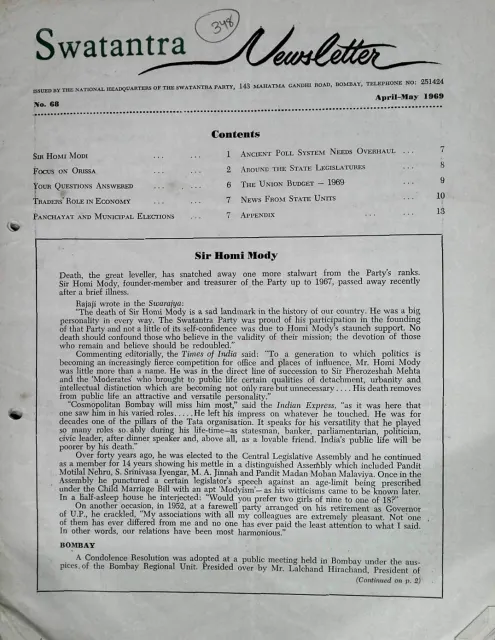
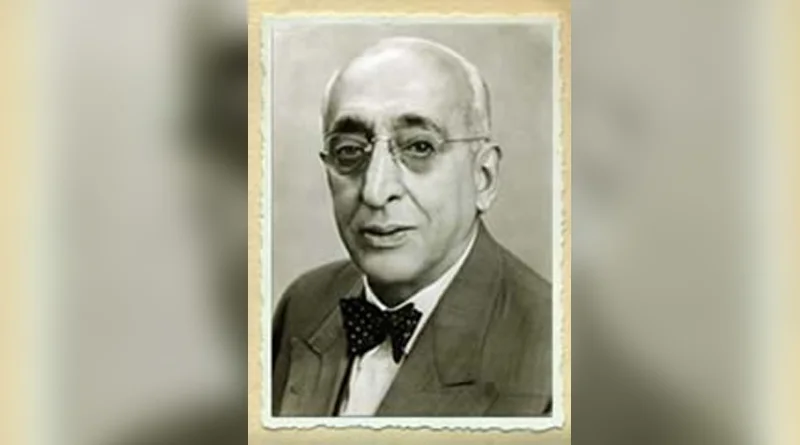
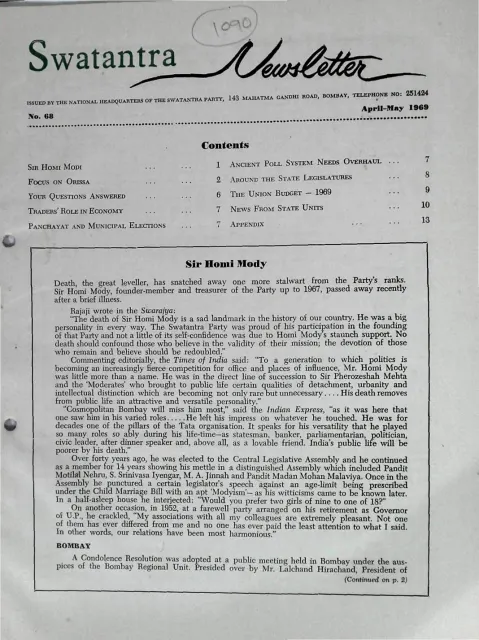
Swatantra Newsletter No. 68 (April–May 1969), issued from the party’s national headquarters at 143 Mahatma Gandhi Road, Bombay, opens with an extended obituary of Sir Homi Mody, the founder-member and treasurer of the Swatantra Party until 1967. Tributes are drawn from Rajaji’s column in Swarajya, from the Times of India and Indian Express, from a Bombay Municipal Corporation resolution moved by Shanti Patel and seconded by P. S. Navalkar, from Prime Minister Indira Gandhi in the Lok Sabha, and from M. R. Masani speaking on the party’s behalf. The section positions Mody as a bridge between Pherozeshah Mehta’s Moderate tradition and independent India’s public life — statesman, industrialist and Party elder.
The issue’s centrepiece is a substantial exclusive interview with R. N. Singh Deo, Orissa’s Swatantra Chief Minister, reprinted from Amrita Bazar Patrika, marking two years of Swatantra–Jana Congress coalition rule. Singh Deo defends the coalition as a pragmatic partnership of like-minded parties, credits the implementation of the 21-point common programme (abolition of land revenue, Panchayat tax and Panchayatiraj law, rooting out administrative corruption, an enquiry commission, moves against dogmatic ‘isms’ in state-owned enterprises), argues that the Centre discriminates against non-Congress states in loans and grants, and calls for a ‘union of non-Congress States’ to bargain constitutionally with New Delhi. He is candid about the failures of the Hirakud and Hanadi Delta projects, the fertiliser shortfall at Paradeep, the Talcher Fertilizer Plant, and the stalled Kendu Leaf Policy under Biju Patnaik’s earlier ministry.
‘Your Questions Answered’ reproduces four questions from E. V. Joseph of the Kerala unit and the General Secretary’s replies on the party’s anti-Hindi stand, Rajaji’s Kashmir position, the Privy Purses, and dealings with the DMK and Shiv Sena — the latter treated as ‘political outcasts’ but symptomatic of the failure of Centre–State relations. Shorter dispatches cover Masani’s Rajkot call for proportional representation, the party’s Tamil Nadu municipal gains, tribute meetings for Homi Mody in Madras, and a state-legislature round-up covering Andhra, Bihar, Punjab, Gujarat, West Bengal, Rajasthan and Tamil Nadu.
The issue closes with an appendix analysing the Union Budget of 1969, framed as a memorandum by the party’s National Executive against the Finance Minister Morarji Desai’s proposals. It rejects the taxes on fertilisers, power pumps, motor spirit and superior kerosene, the agricultural wealth tax, compulsory procurement and food zones — arguing that they will ‘punish the farmer for producing more’ and derive from what the paper calls the ‘communist obsessions’ of a former Prime Minister. The three-point party demand printed on the back cover — abolish food zones and compulsory procurement, drop the input taxes, and abandon the wealth tax on agriculture — sets the polemical frame: ‘India’s prosperity depends on the farmer.‘
Key points
- Obituary section for Sir Homi Mody assembles condolences from Rajaji (in Swarajya), Times of India, Indian Express, Indira Gandhi, M. R. Masani and civic bodies in Bombay and Madras, framing him as heir to Pherozeshah Mehta’s Moderate tradition.
- R. N. Singh Deo interview presents the Swatantra–Jana Congress coalition in Orissa as a pragmatic, 21-point programme government that has abolished land revenue and Panchayat tax and prosecuted corrupt officials.
- Singh Deo argues the Centre systemically underfunds non-Congress states through loans rather than grants and calls for a constitutional ‘union of non-Congress States’ — an early formulation of an opposition federal front.
- The General Secretary’s replies to E. V. Joseph invoke the party’s 21st Principle to permit members individual expression on the Hindi question, while defending Rajaji’s Kashmir statement as historical fact within the Indian Union framework.
- M. R. Masani, speaking to newsmen at Rajkot on 27 February 1969, argues for proportional representation on the ground that the ruling Congress commands only 37% of the Lok Sabha vote yet 55% of seats.
- State-legislature round-up documents Swatantra parliamentary work across seven states — from Sardar Basant Singh’s transport-denationalisation intervention in Punjab to R. Krishnaswamy Gounder’s opposition to Tamil Nadu’s Cultivating Tenants Protection amendment.
- The Union Budget appendix is drafted as a farmers’-interest polemic against Morarji Desai’s 1969 Budget: opposes fertilizer taxes (Rs. 108/tonne on N, Rs. 40/tonne on P₂O₅), power-pump and kerosene duties, and an agricultural wealth tax to be handed to the States ‘for squandering’.
- State units (Mysore under N. K. Ganapaiah, Bombay Region under Lalchand Hirachand, UP, Gujarat) pass resolutions and organise farmer meetings condemning compulsory procurement, food zones and tax proposals — a coordinated mobilisation on the eve of the Budget.
Metadata and summary are AI-extracted from the source PDF and reviewed for editorial accuracy. The original work is available via the Read PDF tab above (where present); paragraph-level citation inside the PDF is deferred to a future engagement.