periodical issue
Swatantra Newsletter
Issued by the National Headquarters of the Swatantra Party, 143 Mahatma Gandhi Road, Bombay, Telephone No: 251424 · Bombay · 1969
16 pages
Summary
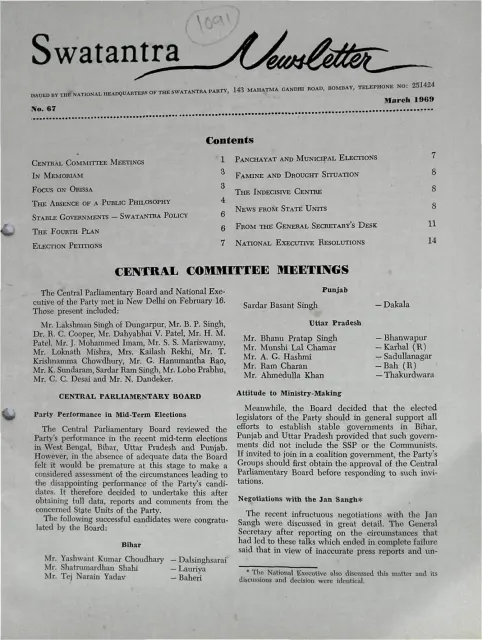
Issue No. 67 (March 1969) of the Swatantra Newsletter, issued by the National Headquarters of the Swatantra Party in Bombay, is a party-organ omnibus. It reports on the Central Parliamentary Board and National Executive meetings held in New Delhi on 16 February, prints editorial features on the Party’s ideology, carries election-petition and state-unit dispatches, and reproduces the full text of the nine resolutions adopted by the National Executive.
The political spine of the issue is coalition strategy in the wake of the 1969 mid-term elections in West Bengal, Bihar, Uttar Pradesh and Punjab. General Secretary N. Dandeker’s press statement of 3 March lays out the doctrine: Swatantra will support stable non-Congress, non-Communist governments where possible; where such governments cannot be formed without Communist support, Congress-led coalitions may be tolerated only if they exclude Communists, forswear direct taxes on the peasantry, and drop compulsory foodgrain procurement. His own signed ‘Why Swatantra?’ letter (From the General Secretary’s Desk) defends the Party’s socio-economic distinctiveness against a proposed ‘Democratic Coalition’ being canvassed by Congressmen, and reads polarization into two or three like-minded blocs as the necessary prelude to a stable democratic order.
Minoo Masani’s Fourth Birthday Lecture excerpts, delivered at Ahmedabad on the theme of Public Philosophy, frame the ideological argument. His concluding 9 February address at the Ahmedabad Management Association attacks the Fourth Plan as a repeat of the failures of the Second and Third, blaming a ‘lopsided order of priorities’ that neglected agriculture and privileged controls, autocracy and excessive taxation. State-unit reporting covers R. N. Singh Deo’s industrial and land-reform initiatives as Chief Minister of Orissa, Prof. N. G. Ranga’s on-the-spot report on the Srikakulam cyclone and Indira Gandhi’s reply, Bombay unit responses to riots, and famine handling in Rajasthan under Maharani Gayatri Devi’s scrutiny.
The National Executive resolutions oppose the Government’s proposals to levy an agricultural income tax and to monopolise imports of industrial raw materials through the State Trading Corporation, condemn the continuing food-zone system, demand genuine famine relief in Bikaner, Jodhpur and Jaisalmer, and denounce mob violence in Bombay City. The issue closes with a signed note by J. R. D. Tata, ‘The Huge Cost of Delay,’ quantifying the exchequer’s losses on the Tata truck project caused by 300 days of government indecision at Rs. 75 crores plus roughly Rs. 92 crores per year in foreign-exchange savings foregone.
Key points
- The Central Parliamentary Board and National Executive met at New Delhi on 16 February 1969 to review mid-term election performance in West Bengal, Bihar, Uttar Pradesh and Punjab, and to set the last date for membership renewal and Party elections.
- Dandeker’s 3 March press statement fixes Swatantra’s coalition policy: support stable non-Congress non-Communist governments; tolerate Congress-led coalitions only if they exclude Communists, drop direct taxes on peasants and end compulsory foodgrain procurement.
- The Party lists nine ‘objectives’ it would demand from a supported Bihar government, including removal of zonal barriers on foodgrains, abolition of land revenue on the Orissa pattern, de-nationalisation of road transport, and abolition of the ‘minimum guarantee’ on off-take of electricity for agriculture.
- Masani’s concluding lecture at Ahmedabad on 9 February argues the Fourth Plan will fail like the Second and Third because planners consistently neglect agriculture; he cites a 24.44% agricultural allotment in the Third Plan against 20.09% for industry, and 23.18% versus 23.16% in the 1967-68 annual plan.
- ‘The Absence of a Public Philosophy’ and ‘Why Swatantra?’ together stake out a case for Swatantra as the only opposition holding a coherent socio-economic doctrine distinct from the Congress family and from the ‘denominational’ character of the Jan Sangh.
- Prof. N. G. Ranga’s report to Prime Minister Indira Gandhi on the Andhra cyclone estimates losses in Srikakulam at Rs. 20 crores and charges the state authorities with ‘criminal neglect’; Mrs. Gandhi replies that she has dispatched Jagjivan Ram and Rs. 10,000 for immediate relief.
- National Executive resolutions oppose an agricultural income-tax, condemn the State Trading Corporation’s proposed monopoly on industrial raw-material imports as driven by ‘wrong economics, faulty ideologies and corrupt political considerations’, and call for genuine famine action in Bikaner, Jodhpur and Jaisalmer.
- J. R. D. Tata’s closing signed note calculates that 300 days of delay on the Tata truck project has cost the exchequer Rs. 75 crores plus about Rs. 92 crores per year in foreign-exchange savings foregone.
Metadata and summary are AI-extracted from the source PDF and reviewed for editorial accuracy. The original work is available via the Read PDF tab above (where present); paragraph-level citation inside the PDF is deferred to a future engagement.