Summary
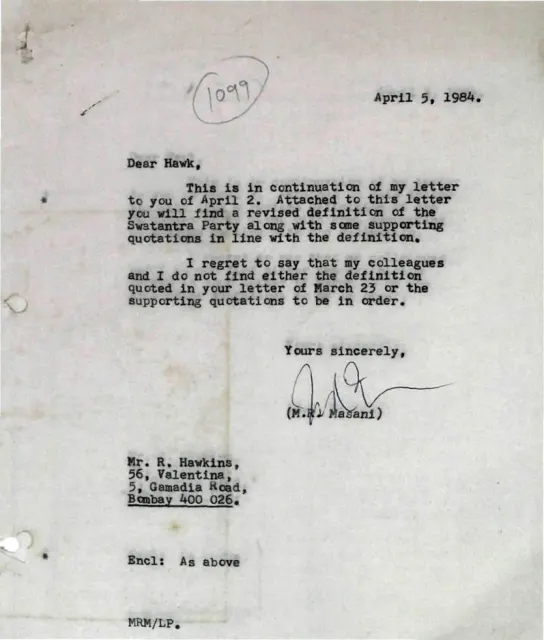
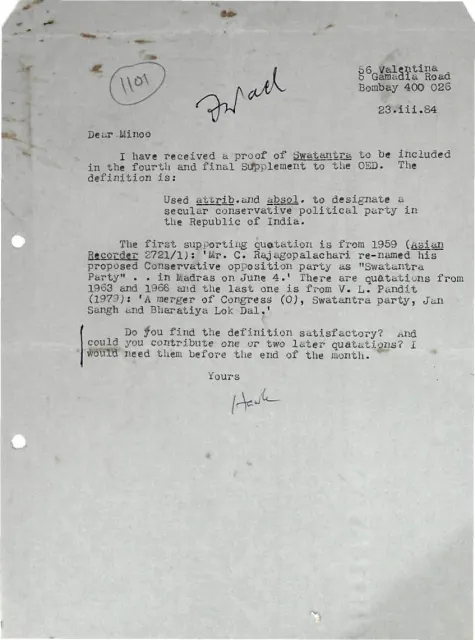
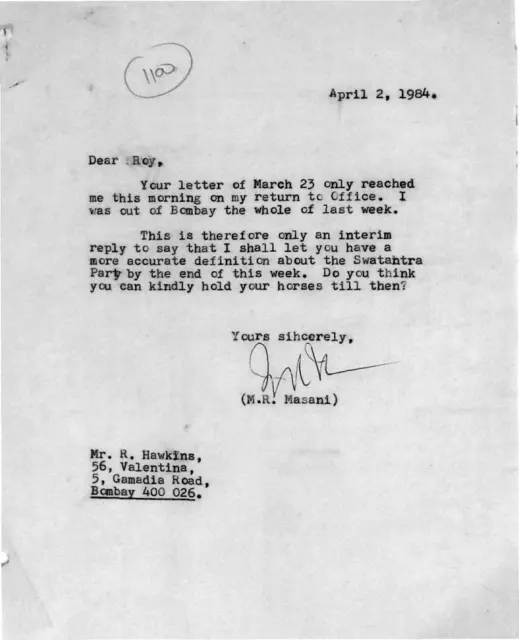
This short archival packet contains a 2 April 1984 letter from M. R. Masani to Mr. R. Hawkins (addressed as ‘Roy’), together with the ‘Revised Definition’ of the Swatantra Party that Masani promised to send by the end of that week. In the covering letter Masani apologises that Hawkins’s letter of 23 March only reached him on his return to Bombay, asks his correspondent to ‘hold your horses’ for a few more days, and signals that the fuller, more accurate definition will follow. The definition itself and its supporting quotations form the bulk of the pages, evidently prepared for inclusion in a dictionary or reference work.
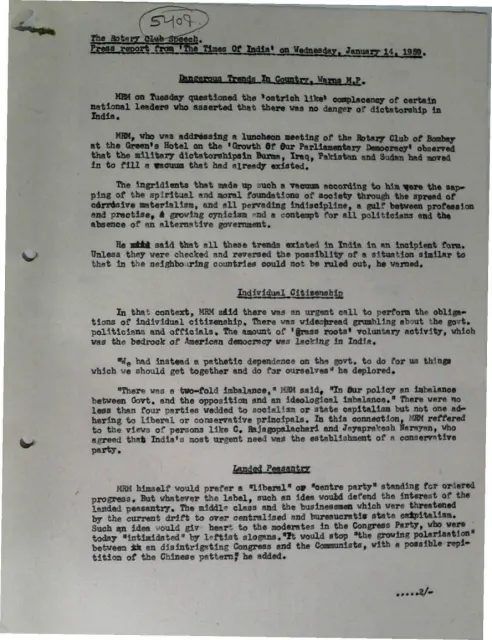
The ‘Revised Definition’ fixes the Swatantra Party as ‘the Freedom Party (a liberal conservative political party) in the Republic of India from 1959 to 1972,’ and glosses the Hindi word Swatantra as ‘self-determined or self-motivated,’ underscoring the party’s stress on individual freedom and its opposition to collective farming, étatisme, socialism and communism. Masani buttresses this definition with six numbered quotations. The first four are drawn from his own writings and speeches (a 1959 Rotary Club of Bombay address quoted in his 1981 memoirs Against the Tide, a 1959 Life magazine article quoted in Congress Misrule and the Swatantra Alternative, his opening remarks at the 1959 Swatantra Party Preparatory Convention, and a passage from his book Liberalism); the last two are drawn from C. Rajagopalachari’s addresses to the party’s Preparatory Convention (August 1959) and Sixth National Convention (April 1972).
Read together, the quotations articulate the party’s self-understanding: a liberal or centre party ‘standing for ordered progress’ that would defend the landed peasantry, the middle class and the businessman against ‘over-centralised and bureaucratic State Capitalism’; a coalition asking the urban middle classes to ‘join hands with the peasants in the villages in defence of their rights and property’; a programme so close to that of the German Social Democrats of 1959 that Masani could publish the two in parallel columns; and, in Rajagopalachari’s formulations, a party pledged to ‘social Justice’ and ‘equality of opportunity for all people’ grounded in ‘individual incentive, enterprise and energy.’ The packet is thus at once a piece of Masani’s late correspondence and a compact, self-authored primer on how the Swatantra Party wished to be defined for posterity.
Key points
- Interim letter of 2 April 1984 from M. R. Masani in Bombay to Mr. R. Hawkins (56 Valentina, 5 Gamadia Road), promising a more accurate definition of the Swatantra Party by week’s end.
- The attached ‘Revised Definition’ fixes the party as ‘the Freedom Party (a liberal conservative political party) in the Republic of India from 1959 to 1972.’
- Glosses the Hindi word Swatantra as ‘self-determined or self-motivated,’ foregrounding individual freedom and opposition to collective farming, étatisme, socialism and communism.
- Six numbered quotations support the definition — four from Masani (1959 Rotary address, 1959 Life article, 1959 Preparatory Convention remarks, and his book Liberalism) and two from C. Rajagopalachari (1959 and 1972 convention addresses).
- Masani frames Swatantra as the only Indian party ‘adhering to Liberal or conservative principles’ at a time when four other parties were ‘wedded to socialism or State capitalism.’
- Notes that Rajagopalachari and Jayaprakash Narayan, from otherwise dissimilar backgrounds, agreed on India’s need for a Conservative or centre party defending peasants, middle class and businessmen.
- Records Masani’s striking claim that the Swatantra Party’s August 1959 programme, set in parallel columns with the German Social Democratic Programme of November 1959, read as ‘a translation or paraphrase’ of the other.
- Rajagopalachari’s quoted formulations bind ‘social Justice’ and ‘equality of opportunity’ to ‘individual incentive, enterprise and energy,’ presenting anti-statism as a moral rather than merely economic stance.
Metadata and summary are AI-extracted from the source PDF and reviewed for editorial accuracy. The original work is available via the Read PDF tab above (where present); paragraph-level citation inside the PDF is deferred to a future engagement.