circular
MANAV NIRMAN
HINDUSTANI MOVEMENT, INDIANS IN SERVICE OF INDIA, 84/A Nepean Sea Road, Bombay-6 · Bombay · 1977
2 pages
Summary
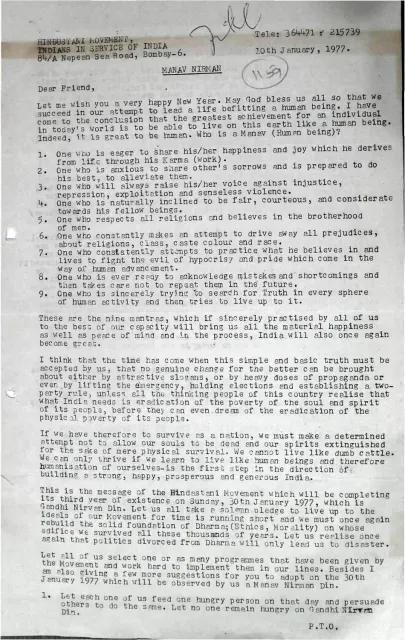
This is a New Year circular dated 10 January 1977, written on Hindustani Movement letterhead (“Indians in Service of India”) by Madhu Mehta, the Movement’s National Convenor, and addressed to friends and members. As the organisation approaches its third anniversary on 30 January 1977 — which coincides with Gandhi Nirvan Din, the death anniversary of Mahatma Gandhi — Mehta uses the letter to articulate the Movement’s philosophy of “Manav Nirman” (human building) and to propose concrete observances for members on that day.
The first half of the letter enumerates nine “mantras” describing the ideal Manav (human being): one who shares happiness derived from Karma (work), consoles others’ sorrows, raises his or her voice against injustice, exploitation and senseless violence, is fair and courteous, respects all religions, works to dissolve prejudices of religion, class, caste, colour and race, fights hypocrisy and pride, acknowledges mistakes without repeating them, and sincerely searches for Truth in every sphere. Mehta argues that only if these mantras are practised will India regain material happiness, peace of mind and greatness.
The argumentative centre of the letter is a critique of purely political solutions to India’s condition, written during the Emergency but before its lifting. Mehta contends that no genuine change can come from “attractive slogans,” “heavy doses of propaganda,” or “even by lifting the emergency, holding elections and establishing a two-party rule,” unless the country’s thinking people first recognise that the poverty of the soul must be eradicated before physical poverty can be. He calls for “humanisation of ourselves” as the first step to national reconstruction and warns that politics divorced from Dharma will only lead to disaster.
The letter closes with a seven-point programme for members to observe on 30 January 1977 — feed a hungry person, mobilise neighbours in a mohalla so no one remains hungry, avoid encouraging idlers while serving the truly needy, spend an hour with poor children, extract 25-point-programme pledges from Congressmen and women, redirect opposition workers away from an obsession with “Smt. Gandhi” toward concrete service, and urge political leaders to step down from their pedestals and “think like an Indian before you think like a partisan/politician.” Mehta then appeals directly to Prime Minister Indira Gandhi to invite opposition leaders, and Jayaprakash Narayan in particular, to Rajghat on the morning of 30 January to pray together “if not for talks,” and asks readers to write to “Indiraji and J.P.” urging them to do so.
Key points
- Circular letter from Madhu Mehta, National Convenor of the Hindustani Movement, marking its third anniversary on 30 January 1977 (Gandhi Nirvan Din).
- Enumerates nine “mantras” defining a Manav (human being): sharing joy through Karma, consoling others, opposing injustice and exploitation, courtesy, respecting all religions, dissolving prejudices of religion/class/caste/colour/race, fighting hypocrisy, acknowledging mistakes, searching for Truth.
- Argues that neither slogans, propaganda, elections nor the lifting of the Emergency can produce genuine change until India eradicates “the poverty of the soul and spirit” that precedes physical poverty.
- Frames “humanisation of ourselves” and Dharma (glossed as ethics and morality) as prerequisites for building a strong, prosperous India.
- Proposes seven concrete Gandhi-anniversary observances — feeding the hungry, mohalla-level food organising, spending time with poor children, discipline within Congress and opposition, direct engagement between political leaders and ordinary people.
- Appeals to Prime Minister Indira Gandhi to invite opposition leaders, and Jayaprakash Narayan by name, to a common prayer meeting at Rajghat on 30 January 1977.
- Asks members to write personally to Indira Gandhi and J.P. urging them to come together, framing national reconciliation across political divides as a spiritual rather than merely political act.
Metadata and summary are AI-extracted from the source PDF and reviewed for editorial accuracy. The original work is available via the Read PDF tab above (where present); paragraph-level citation inside the PDF is deferred to a future engagement.