letter
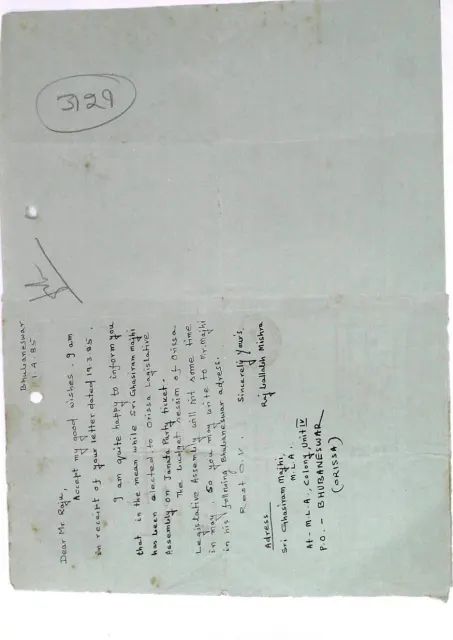
Letter to Mr Minoo Masani
Swatantra Party, Orissa Unit, 312, Kharvelnagar, Bhubaneswar-751001 · Bhubaneswar · 1976
6 pages
Summary
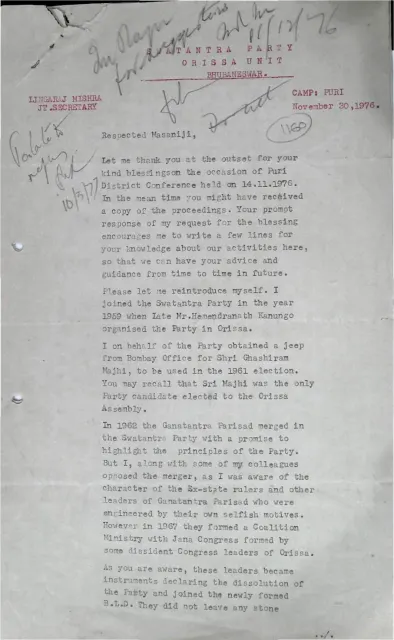
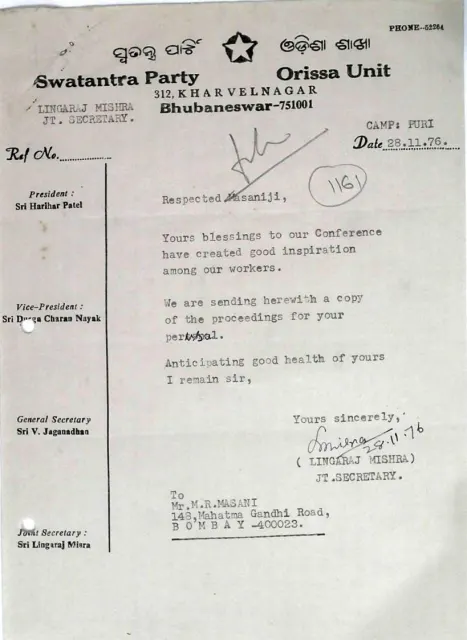
This packet, dated 28 November 1976, contains a brief covering letter from Lingaraj Mishra, Joint Secretary of the Swatantra Party’s Orissa Unit, to Minoo Masani in Bombay, transmitting the proceedings of a Swatantra Party workers’ conference held at Bhubaneswar on 14 November 1976. Mishra thanks Masani for his blessings, notes that they inspired the workers, and encloses the account of the conference for Masani’s personal perusal.
The enclosed five-page proceedings record the addresses delivered at Bhubaneswar. Sri Harihar Patel, President of the Orissa Unit, presided; Sri Nityananda Mahapatra, an ex-Minister and President of the Orissa Jana Congress, inaugurated the meeting and argued that political parties must be built on sound principles rather than on programmes alone, citing the failed Swatantra–Jana Congress alliance as a case of a partnership derailed by wrong actions and bad leadership. A message from Sri K. Sundaram, President of the Swatantra Party (India), warned that after the recent amendment of the Constitution the opposition should abandon thoughts of power and devote itself instead to the political education of the masses, staying firm on principle. A congratulatory message from Sri V. S. Srikumar of Madras invoked Satya Meva Jayate and urged the workers to believe that although a battle over the constitutional amendment had been lost, the war would still be won.
In his presidential address, Harihar Patel presented the Swatantra Party as “a party with a difference” whose principles reflect eternal values rooted in Indian tradition and culture. He recalled that Rajaji, at an earlier Bhubaneswar session, had exhorted everyone — Swatantra member or not — to work for these ideals from their own stations. Patel was sharply critical of the prevailing electoral system for hiding the individual candidate behind the party symbol, and of the ruling party’s legislative posture, which he described as founded on distrust of the individual and therefore as “denial and destruction of democracy.” The net effect, he argued, was a systematic depersonalisation of public life; socialism could only be meaningful as an attribute of the individual, and government was instead depriving citizens of basic rights, fundamental freedoms and property rights, a trend that the recent constitutional amendment would only accentuate.
The proceedings close with practical organisational business: an exhortation to workers to internalise party principles and propagate them in daily life without needing high-expenditure campaigns; participation from a number of Orissa workers; a homage offered to the departed Pandit Nehru on the occasion of his birthday, noting his willingness to retrace steps when faced with criticism; and the formation of an ad-hoc committee for Puri district to co-opt members and elect office bearers.
Key points
- Covering letter from Lingaraj Mishra, Joint Secretary of the Swatantra Party’s Orissa Unit at Bhubaneswar, to Minoo Masani at 148 Mahatma Gandhi Road, Bombay, dated 28.11.76 and signed from Camp: Puri.
- Encloses the proceedings of a Swatantra Party workers’ conference held at Bhubaneswar on 14 November 1976, presided over by Sri Harihar Patel.
- The inaugural address by ex-Minister Nityananda Mahapatra insisted that parties must be built on distinct principles, not merely programmes, and treated the collapsed Swatantra–Jana Congress alliance as a cautionary example.
- A message from K. Sundaram, President of the Swatantra Party (India), argued that after the constitutional amendment the opposition should give up on power and concentrate on the political education of the masses.
- Harihar Patel’s presidential address framed the Swatantra Party as one of eternal, tradition-rooted principles and denounced the electoral system for burying the individual candidate behind the party symbol.
- Patel diagnosed the state’s legislative direction as “distrust of the individual” amounting to a denial of democracy, and warned that the constitutional amendment would accentuate the depersonalisation of public life.
- Socialism, in Patel’s rendering, can only be an attribute of the individual, whereas government is systematically stripping citizens of basic rights, fundamental freedoms and property rights.
- The conference offered homage to Pandit Nehru on the occasion of his birthday and constituted an ad-hoc committee for Puri district to co-opt members and elect office bearers.
Metadata and summary are AI-extracted from the source PDF and reviewed for editorial accuracy. The original work is available via the Read PDF tab above (where present); paragraph-level citation inside the PDF is deferred to a future engagement.