letter
Letter to Mr Minoo Masani
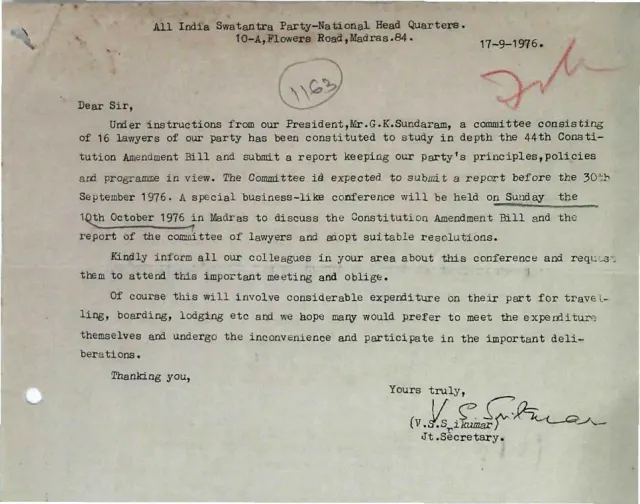
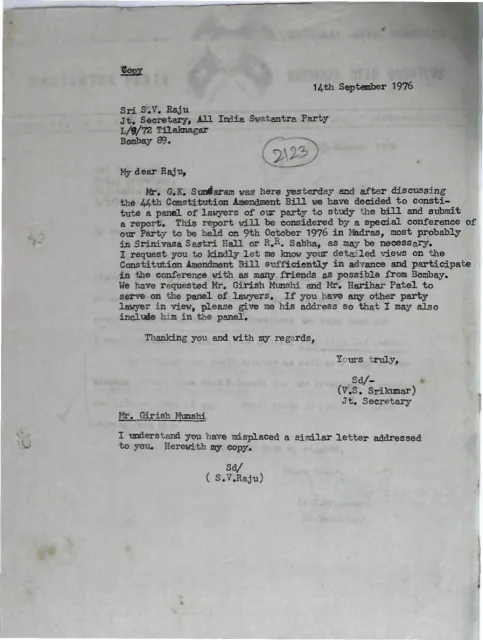
SWATANTRA PARTY NATIONAL HEAD QUARTERS, 10-A, FLOWERS ROAD, MADRAS-600 084 · Madras · 1976
5 pages
Summary
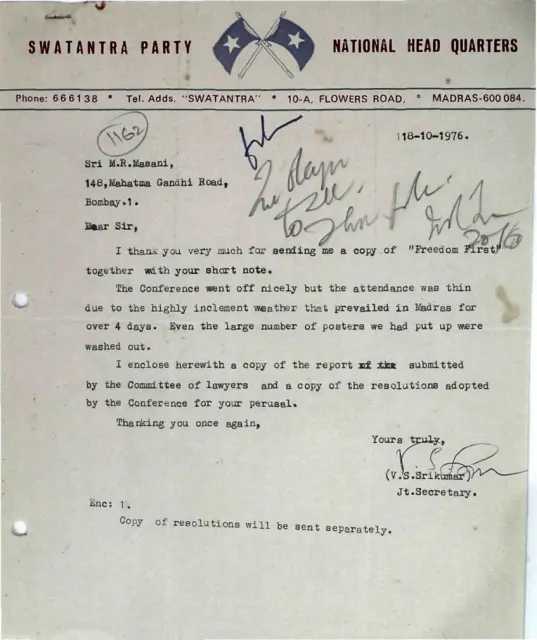
A short covering letter dated 18 October 1976 from V. S. Srikumar, Joint Secretary at the Swatantra Party’s National Head Quarters in Madras, to Minoo Masani in Bombay, encloses the Party’s formal opinion on the Constitution (Forty-Fourth Amendment) Bill, 1976. Srikumar thanks Masani for a copy of Freedom First and its accompanying note, reports that a recent Madras conference “went off nicely but the attendance was thin due to the highly inclement weather that prevailed in Madras for over 4 days”, and forwards the report of a Committee of Lawyers set up by the All India Swatantra Party together with the resolutions adopted, promising the resolutions text separately.
The enclosed report, dated Madras 15 October 1976 and signed off by a seventeen-member Committee of Lawyers (R. M. Seshadri, Girish Munshi, Harihar Patel, S. Pichai, N. Ramanatha Iyer, Peppin Fernando, Narayana Rao, K. C. Kadirvelu, R. Krishnamurthy, V. Padmanabhan, Ajmal Khan, Gopalakrishnan, Sankaranarayanan, G. Sundaram, Appavoo, K. V. Ramamurthy and S. N. Sadasivam), sets out the Party’s general position and then makes clause-by-clause objections to the Bill. The general position holds that the Party “in its dedication to the welfare of the people is second to none” but is apprehensive about the method: the objects sought can be achieved within the existing constitutional frame if government applies its mind, and any large-scale amendment that alters the basic structure sets an unhealthy precedent and invites successor governments to do the same. The report warns that with press censorship in force and “large number of leaders being detained in prison without trial”, wide-spread debate is impossible and the Government therefore lacks the moral, if not the legal, authority to push through so sweeping a rewrite. It recommends that an Expert Committee of jurists first examine whether the stated objectives can be met within the existing Constitution.
The clause-by-clause objections attack the additions of “Secular” and “Social” to the Preamble as redundant and imprecise (Clause 2); reject the immunity from judicial scrutiny for measures taken to implement Part IV of the Constitution as a “negation of Rule of Law” (Clause 4, Art. 31(c)); demand a tighter definition of “anti-national activities” (Clause 5, Art. 31D); condemn Clause 6 (Art. 32(A)) for putting justice out of reach of the poor; and criticise the fundamental-duties chapter as “vague and more of pious wishes than of practical use” (Clause 10, Part IV A). Further objections argue that compelling the President to act on Cabinet advice “seriously detracts from the status and the privileged position that the President of India enjoys” (Clause 13, Art. 74); that fixing a numerical proportion in a Supreme Court Bench for declaring laws invalid is opposed to prevailing practice and “unfortunate” legislative drafting (Clause 42, Art. 228A); and that Clause 51 (Art. 357), which continues the life of a law passed under extraordinary power after that power has ceased, is indefensible.
Key points
- Cover letter of 18 October 1976 from V. S. Srikumar (Jt. Secretary, Swatantra Party National Head Quarters, Madras) to Minoo Masani, acknowledging a copy of Freedom First and enclosing the party’s Committee-of-Lawyers report plus resolutions from the Madras Conference.
- Report by a 17-member Committee of Lawyers, dated Madras 15 October 1976, gives the Swatantra Party’s considered response to the Constitution (Forty-Fourth Amendment) Bill, 1976.
- Party position: welfare-state objectives are shared but do not require rewriting the Constitution on a large scale; existing frame suffices if the Government applies its mind properly.
- Any amendment that “unquestionably alters the basic structure” is treated as an unhealthy precedent and an invitation to successor governments to do the same.
- Because press censorship is in force and many leaders are in prison without trial, no wide-spread public debate is possible; the Government therefore lacks the moral authority to push through a sweeping amendment.
- Recommends an Expert Committee of jurists to test whether the Bill’s objectives can be secured within the existing constitutional frame.
- Clause-level objections: no need to insert “Secular” and “Social” in the Preamble (Cl. 2); Art. 31(c) removes the executive from judicial scrutiny and negates Rule of Law (Cl. 4); “anti-national activities” needs precise definition (Cl. 5); Art. 32(A) puts justice beyond the poor (Cl. 6); fundamental duties are vague and pious rather than practical (Cl. 10).
- Further objections: compelling the President to follow Cabinet advice detracts from the office (Cl. 13, Art. 74); numerical benches to invalidate laws are opposed to precedent (Cl. 42, Art. 228A); continuing extraordinary-power laws beyond the emergency has no justification (Cl. 51, Art. 357).
Metadata and summary are AI-extracted from the source PDF and reviewed for editorial accuracy. The original work is available via the Read PDF tab above (where present); paragraph-level citation inside the PDF is deferred to a future engagement.