letter
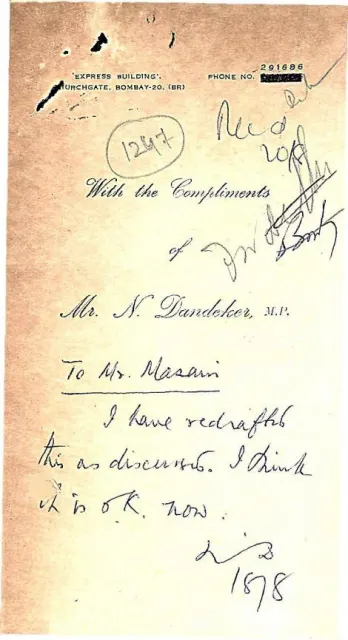
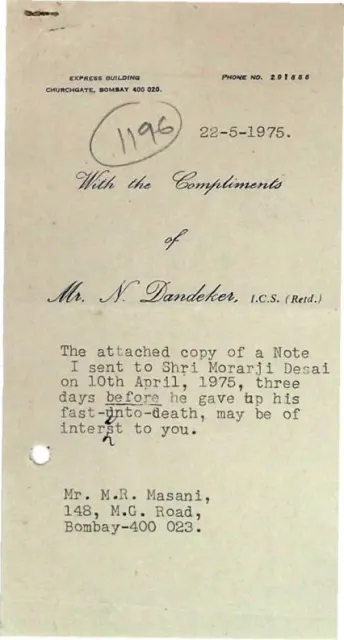
With the Compliments of N Dandeker
Bombay · 1975
3 pages
Summary
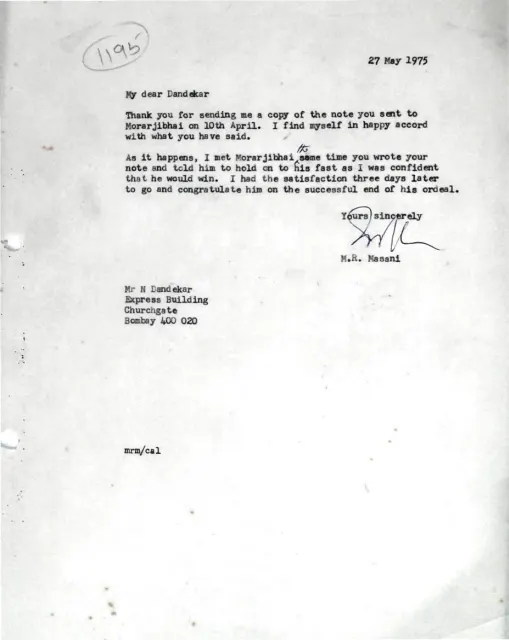
This three-page item is a compliments slip from N. Dandeker, I.C.S. (Retd.), sent on 22 May 1975 from the Forum’s Express Building address in Churchgate to Minoo Masani, forwarding the text of a private note Dandeker had addressed to Morarji Desai on 10 April 1975 — three days before Desai broke his fast-unto-death. Dandeker sends the enclosure as material of likely interest to a fellow Swatantra veteran at a moment when Desai’s tactical choice had become national news.
The note itself, written directly to Desai, walks through the questions Dandeker says well-wishers and friends of “Morarjibhai” were asking: what the fast was really for, whether a fast-unto-death is ever justifiable, and what Desai hoped to achieve. Dandeker argues that Desai’s step was compelled by a specific political outrage — the Centre’s refusal to permit fresh elections in Gujarat after a popular uprising had unseated a corrupt State ministry, and its use of what he calls a “phoney ‘Emergency’” to prolong President’s Rule indefinitely. Drawing on his own service as an officer who had both conducted elections and administered Famine Works, he dismantles the official argument that relief works made polling impracticable, treating it as a politically motivated pretext designed to mislead.
He then contrasts Gujarat with Bihar, where the Legislature was kept in place despite having ceased to represent popular opinion, dismissing its reconstituted form as a “rump legislature” in a State also marked by corruption and famine. Faced with this “utterly unresponsive, dictatorial and unethical attitude of the Central Govt.”, Dandeker catalogues the options open to a highly perceptive public figure — silence, symbolic protest, imprisonment, or the kind of suicide seen in Russia, China, Austria and Czechoslovakia — and concludes that only a non-violent fast-unto-death remains ethically available. He closes by admitting no one can predict whether the fast will succeed, but expresses a “pious hope” that the hundreds of thousands then engaged on Gujarat’s famine works may “down tools” in solidarity until State elections are announced.
Key points
- Covering slip dated 22-5-1975 forwards to M. R. Masani a note Dandeker had sent to Morarji Desai on 10 April 1975, three days before Desai ended his fast.
- The note frames three questions well-wishers were asking about Desai’s fast: its object, its justifiability, and what he hoped to achieve.
- Dandeker locates the immediate provocation in the Centre’s refusal to hold fresh Gujarat elections after a popular uprising had displaced a corrupt State government under President’s Rule.
- Rejects the Government’s Famine-Works excuse for postponing polls, drawing on his own past service running both elections and famine relief.
- Contrasts Gujarat with Bihar, where the Legislature was kept alive as a ‘rump legislature’ despite having ceased to be representative and despite rampant corruption.
- Frames a fast-unto-death as, ethically, the only remaining ‘acceptable answer’ for morally strong public figures short of silence, imprisonment, or suicide of the Czechoslovak or Hungarian kind.
- Closes with the ‘pious hope’ that Gujarat’s famine-works labourers might down tools in sympathy until State elections are called.
Metadata and summary are AI-extracted from the source PDF and reviewed for editorial accuracy. The original work is available via the Read PDF tab above (where present); paragraph-level citation inside the PDF is deferred to a future engagement.