
circular
Circular No-322
Swatantra Party · Madras · 1975
4 pages
Summary
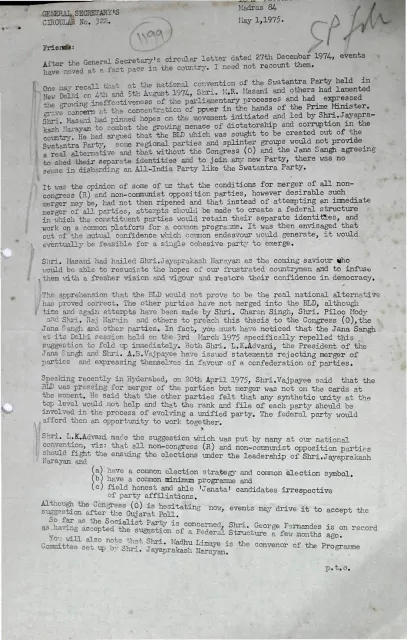
Circular No. 322, issued from the Swatantra Party’s new Madras headquarters on 1 May 1975, is General Secretary Girish Munshi’s follow-up to his December 1974 dispatch. It reviews the fragmentation of India’s non-Congress (R), non-communist opposition since Shri M.R. Masani and others warned, at the party’s August 1974 national convention in New Delhi, of the parliamentary process’s growing ineffectiveness and the concentration of power in the Prime Minister’s hands. Masani had staked hopes on the movement led by Shri Jayaprakash Narayan against ‘the growing menace of dictatorship and corruption’; the circular’s core argument is that this hope has been vindicated even as the immediate project of merging opposition parties into the Bharatiya Lok Dal has stalled, with the Jana Sangh and A.B. Vajpayee rejecting merger in favour of a looser confederation and Charan Singh, Piloo Mody, Raj Narain and others failing to bring the Jana Sangh in.
The circular then declares Jayaprakash Narayan ‘the logical Gandhian successor to Shri Rajaji’, endorses his ‘Total Revolution’ as consonant with long-standing Swatantra doctrine, and enumerates its five pillars — Sarvodaya as an anti-Marxist alternative to class conflict, the moral values of Indian public life, a total but non-violent revolution across social, economic and cultural domains, faith in Lokashakti or Janashakti over Rajashakti, and the preservation of fundamental rights. Munshi reports that a National Coordination Committee has been formed under Shri G.K. Sundaram, that the party has resolved to place its members and machinery at JP’s disposal, and that L.K. Advani has separately proposed a common election strategy and symbol under JP’s leadership for all non-Congress, non-communist parties. He acknowledges the Socialist Party’s George Fernandes has already accepted the federal-structure idea and that Madhu Limaye is convenor of JP’s programme committee.
The second half is an operational report from the National Executive’s 22 January 1975 Bombay meeting and subsequent developments: full support for JP; approval of the Electoral Reforms Committee’s proposals; a demand that unnecessary industrial controls and quota systems be scrapped; criticism of the electoral-roll enumeration; and the shifting of party headquarters to 10-A, Flowers Road, Madras 34 (telegraphic address ‘SWATANTRA’). Legal fronts are active — a writ in the Madras High Court challenging the Election Commission’s freezing of the party symbol, and a Tamil Nadu Swatantra Party suit already decreed in the party’s favour on 10 December 1974 against the claim that the August 1974 national convention’s dissolution vote was invalid. State-level updates from Uttar Pradesh, Orissa, Rajasthan, Gujarat, Maharashtra and Karnataka round out an account of a party that, though formally dissolved at the national level, is regrouping around JP’s movement while asserting its own organisational continuity.
Key points
- General Secretary Girish Munshi writes from the party’s new Madras 34 headquarters on 1 May 1975, following his 27 December 1974 circular.
- The circular reports that the projected merger of non-Congress (R), non-communist opposition parties into the Bharatiya Lok Dal has failed: the Jana Sangh, at its 3 March 1975 Delhi session, formally rejected merger, and Vajpayee has publicly endorsed a mere confederation.
- Masani’s warning of ‘growing ineffectiveness of the parliamentary process’ and concentration of power in the Prime Minister’s hands, delivered at the 4-5 August 1974 New Delhi convention, is offered as the frame for reading Jayaprakash Narayan’s rise.
- Munshi declares JP ‘the logical Gandhian successor to Shri Rajaji’ and embraces his ‘Total Revolution’ — Sarvodaya, moral revival, non-violent total revolution, Lokashakti/Janashakti over Rajashakti, and fundamental rights — as identical to what Swatantra has long argued.
- A National Coordination Committee has been formed under G.K. Sundaram; L.K. Advani has proposed a common election strategy, minimum programme and ‘Janata’ candidates irrespective of party affiliation under JP.
- The 22 January 1975 National Executive in Bombay resolved on full cooperation with JP, endorsed the Electoral Reforms Committee’s proposals, and urged the removal of industrial controls and quotas.
- The party is contesting the Election Commission’s freezing of its symbol via a Madras High Court writ filed 30 January 1975; provisional use of the symbol ‘STAR’ has been permitted.
- The Tamil Nadu Swatantra Party has already secured a favourable decree (10 December 1974) rejecting the claim that the August 1974 national dissolution vote at Delhi was valid, and state units in UP, Orissa, Rajasthan, Gujarat, Maharashtra and Karnataka are being reconstituted.
Metadata and summary are AI-extracted from the source PDF and reviewed for editorial accuracy. The original work is available via the Read PDF tab above (where present); paragraph-level citation inside the PDF is deferred to a future engagement.
Related across the archive
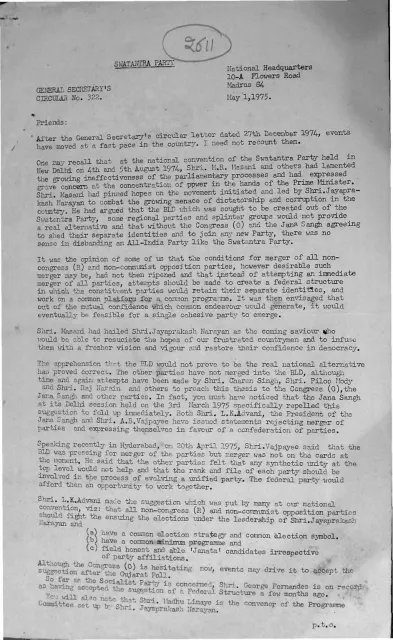 Primary workSwatantra Party National Convention
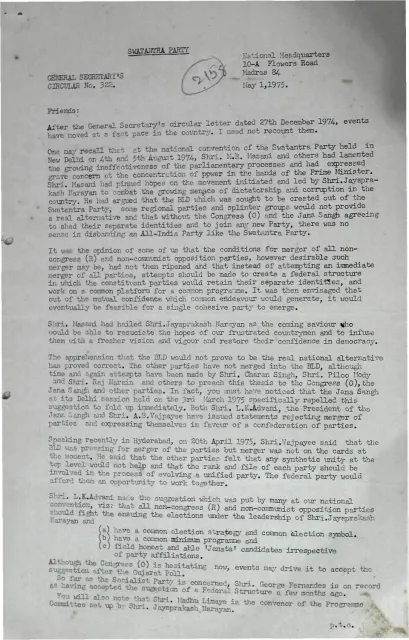 Primary workletter from Mr Girish Munshi
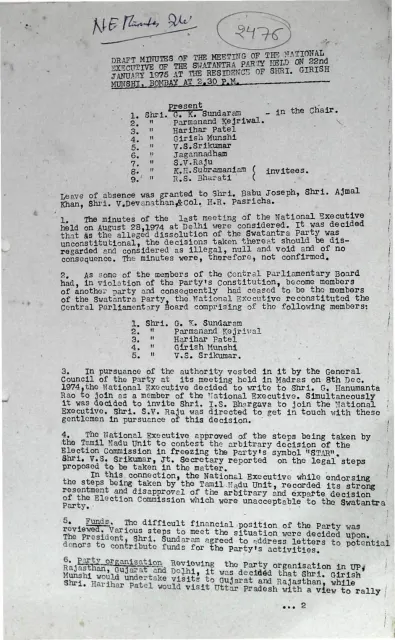 Primary workDRAFT MINUTES OF THE MEETING OF THE NATIONAL EXECUTIVE OF THE SWATANTRA PARTY HELD ON 22nd JANUARY 1975 AT THE RESIDENCE OF SHRI. GIRISH MUNSHI, BOMBAY AT 2.30 P.M.
 Organisationswatantra-party
 OpinionThe Swatantra Way for Forging a Formidable Coalition