letter
Letter to Piloo Mody
Bombay · 1975
1 pages
Summary
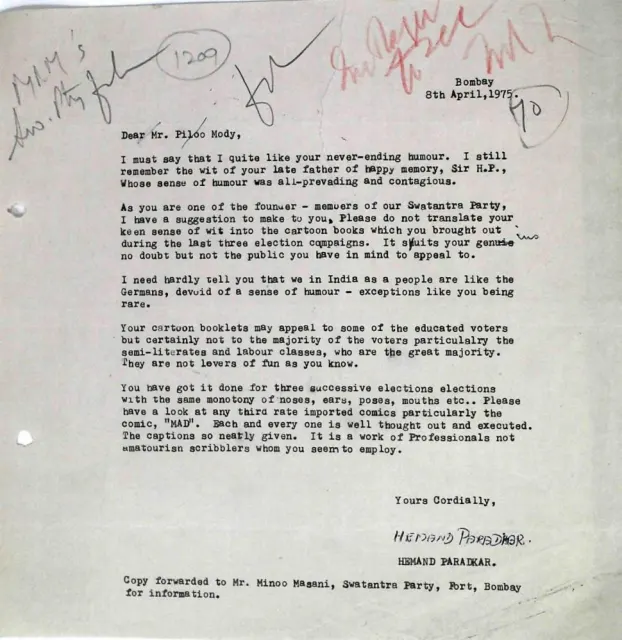
This one-page letter, dated 8 April 1975 and posted from Bombay, is written by Hemand Paraikar to Piloo Mody, a founder-member of the Swatantra Party. Paraikar opens with a personal note of appreciation for Mody’s humour and warmly recalls the wit of Mody’s late father, Sir H. P. (Sir Homi Mody), before turning to the letter’s real purpose: a candid critique of the cartoon booklets Mody has been producing for Swatantra Party’s election campaigns.
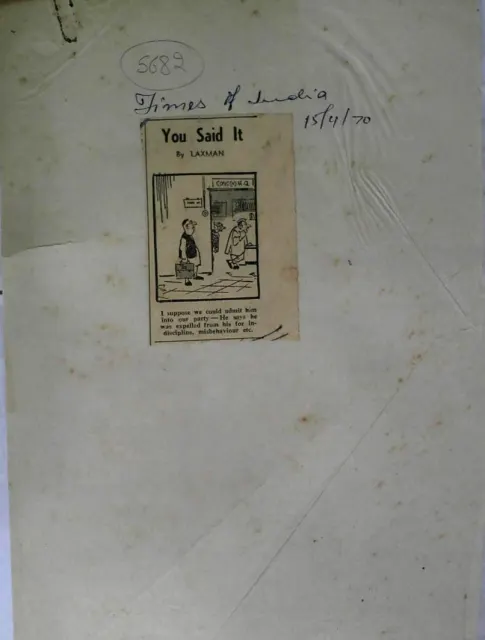
Paraikar’s central argument is one of communication strategy. He contends that Mody’s cartoon books, though clever, are pitched to the wrong audience. Indians on the whole, he claims, are ‘like the Germans, devoid of a sense of humour,’ and while the booklets might amuse the educated voter, they will not land with the semi-literate and labouring majority whose votes decide elections. Three successive campaigns, he complains, have used the same cartoon formula with ‘the same monotony of noses, ears, poses, mouths,’ and the craft has been left to ‘amatourisn scribblers’ rather than professionals of the calibre found in imported comics such as MAD magazine.
The letter closes cordially and notes that a copy has been forwarded to Minoo Masani at the Swatantra Party’s Fort, Bombay office, situating it as an internal intervention within the party’s classical-liberal political circle rather than an outside broadside.
Key points
- A private letter from Hemand Paraikar in Bombay to Piloo Mody, dated 8 April 1975, forwarded in copy to Minoo Masani at the Swatantra Party office in Fort, Bombay.
- Paraikar addresses Mody as ‘one of the founder-members of our Swatantra Party’ and frames the letter as intra-party advice.
- The letter opens with warm remembrance of Mody’s late father, Sir H. P., whose ‘all-prevading and contagious’ sense of humour Paraikar recalls.
- Its main claim is that Mody’s cartoon booklets, produced for three successive election campaigns, misfire with the actual electorate.
- Paraikar argues the booklets appeal only to educated voters and not to the semi-literate and labouring classes who form the voting majority.
- He characterises Indians as generally humourless, likening them to Germans, and treats Mody as a rare exception.
- He objects to the visual monotony of the cartoons (‘noses, ears, poses, mouths’) across successive campaigns.
- He holds up American comics such as MAD as the professional standard the party’s cartoons should emulate rather than the ‘amatourisn scribblers’ currently employed.
Metadata and summary are AI-extracted from the source PDF and reviewed for editorial accuracy. The original work is available via the Read PDF tab above (where present); paragraph-level citation inside the PDF is deferred to a future engagement.