essay
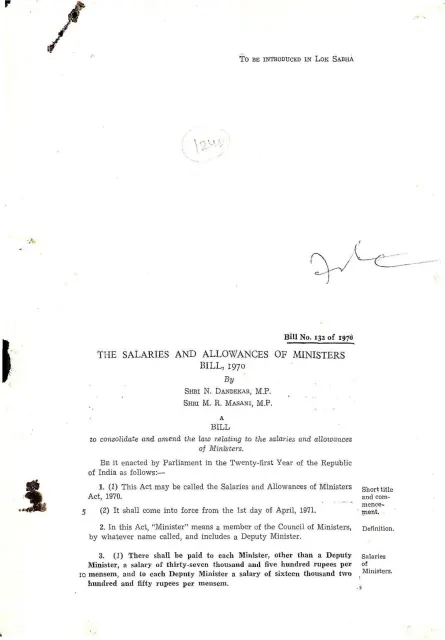
THE SALARIES AND ALLOWANCES OF MINISTERS BILL, 1970.
NOTES ON CLAUSES
By N. Dandekar
1970
2 pages
Summary
This two-page note by N. Dandekar explains the clauses of the Salaries and Allowances of Ministers Bill, 1970. The Bill consolidates and amends the law governing ministers’ salaries and allowances, replacing the framework in the Salaries and Allowances of Ministers Act, 1952, as amended in 1969. It is intended to come into force on 1 April 1971 and repeats the statutory definition of “Minister.”
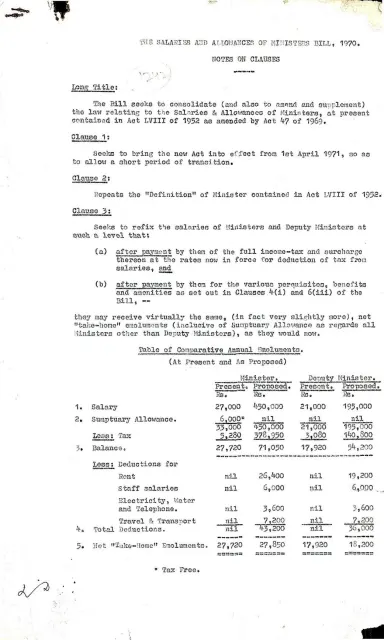
The principal change described is a restructuring of ministers’ and deputy ministers’ remuneration so that, after income tax, surcharge, and deductions for specified benefits and amenities, their net “take-home” amounts remain broadly comparable to existing levels. The note sets out proposed salary figures and deductions for rent, staff, electricity, water, telephone, and travel. It also explains the valuation of benefits, transitional payments after resignation or death, the prohibition of entertainment allowances for ministers other than the Prime Minister, and a requirement that ministers bear Rs. 7,200 per annum for the personal component of official travel. Clauses 7 to 11 are described as making no substantive change, while clause 12 repeals the 1952 Act.
Key points
- The Bill consolidates and amends the existing law on ministers’ salaries and allowances.
- It proposes to bring the new Act into effect on 1 April 1971.
- Ministerial remuneration is recalculated to account for tax, surcharge, perquisites, benefits, amenities, and specified deductions.
- The comparative table lists proposed annual gross and net emoluments for ministers and deputy ministers.
- Perquisites and amenities are valued conservatively below their market values to avoid hardship.
- Entertainment or “sumptuary” allowances are prohibited for ministers other than the Prime Minister.
- The Bill requires ministers to pay Rs. 7,200 per annum for the personal and private-use component of official travel and repeals the 1952 Act.
Metadata and summary are AI-extracted from the source PDF and reviewed for editorial accuracy. The original work is available via the Read PDF tab above (where present); paragraph-level citation inside the PDF is deferred to a future engagement.