legal filing
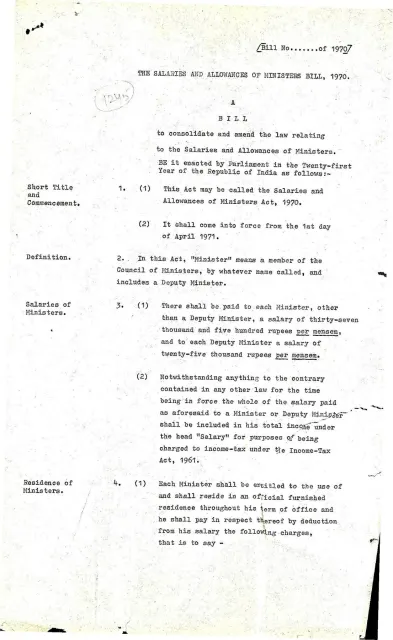
The Salaries and Allowances of Ministers Bill, 1970
1970
8 pages
Summary
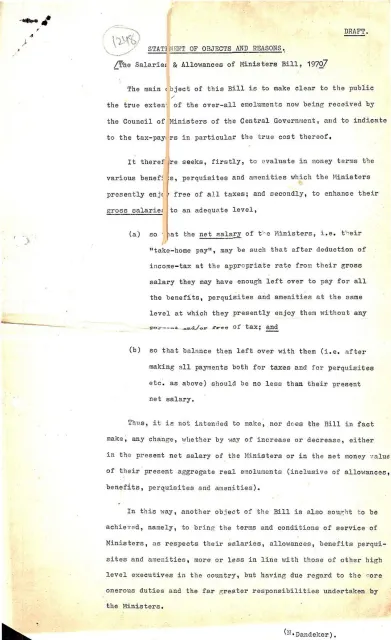
The Salaries and Allowances of Ministers Bill, 1970, sponsored by M. R. Masani and N. Dandeker, is a legislative proposal to consolidate and amend the law governing the remuneration and official benefits of Union ministers. Its statement of objects and reasons says the Bill would make the full value and cost of ministers’ emoluments more transparent to the public and taxpayers by expressing benefits, perquisites, and amenities in monetary terms. It also proposes increasing gross salaries so that ministers’ after-tax income and remaining emoluments would not fall below their existing levels, while bringing their service conditions broadly into line with those of other senior public executives, subject to ministers’ greater responsibilities.
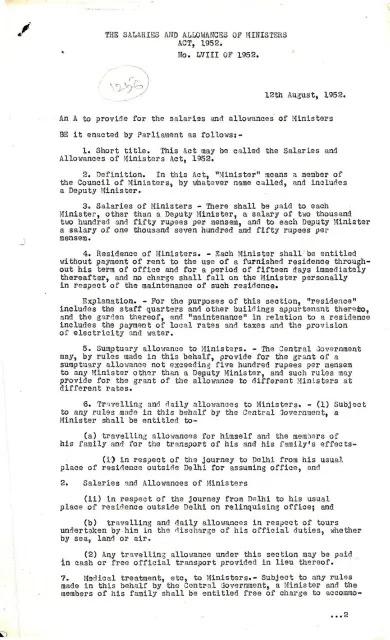
The operative clauses define “Minister” to include deputy ministers; set monthly salaries at Rs. 37,500 for ministers other than deputy ministers and Rs. 16,250 for deputy ministers; and require the salary to be included in taxable income. The Bill provides official furnished residences, specified charges for maintenance and domestic staff, limited post-office residential occupation for ministers and their families, travel and daily allowances, government medical treatment, and repayable advances for motor-car purchases bearing interest at ten per cent per annum. It bars ministers from drawing parliamentary salaries or allowances in respect of their membership of either House, provides for Gazette notification of appointment dates, authorises Central Government rules subject to parliamentary laying, and repeals the Salaries and Allowances of Ministers Act, 1952. The document also includes a memorandum stating that the delegated legislative power is within the usual scope of such delegation.
Key points
- The Bill seeks to disclose the full monetary value and taxpayer cost of ministers’ salaries, benefits, perquisites, and amenities.
- It proposes gross salaries of Rs. 37,500 per month for ministers other than deputy ministers and Rs. 16,250 for deputy ministers.
- The statement of objects and reasons presents the proposal as preserving ministers’ existing net remuneration rather than changing its real value.
- Ministers would receive furnished official residences, with specified charges for residence-related services and staff.
- The Bill regulates travel, daily allowances, medical treatment, and repayable motor-car advances, including ten per cent annual interest on such advances.
- Ministers may not additionally draw salary or allowances as members of either House of Parliament.
- The proposal authorises Central Government rules, requires their placement before both Houses, and repeals the 1952 Act.
Metadata and summary are AI-extracted from the source PDF and reviewed for editorial accuracy. The original work is available via the Read PDF tab above (where present); paragraph-level citation inside the PDF is deferred to a future engagement.