essay
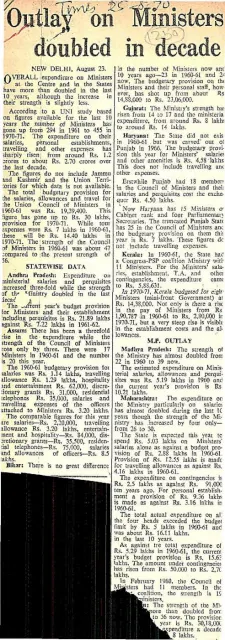
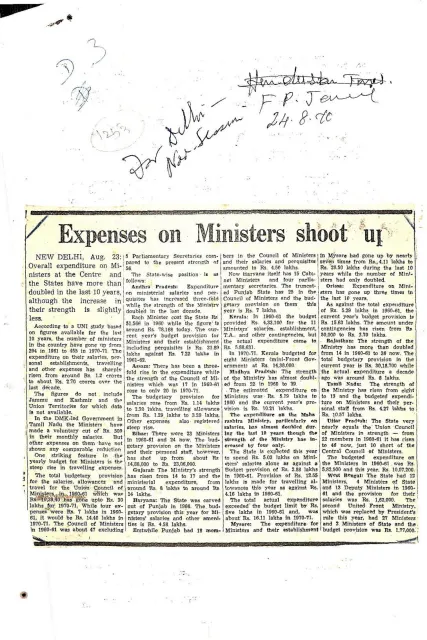
Expenses on Ministers shoot up
NEW DELHI
2 pages
Summary
The rendered pages combine a newspaper clipping on rising ministerial expenditure with a typed continuation of an argument against India’s prevailing form of socialism. The clipping reports that expenditure on ministers, salaries, allowances, travelling expenses, and staff has risen sharply over the preceding decade across the Union and several states, while ministerial strength has also expanded. It presents state-by-state comparisons, including Andhra Pradesh, Assam, Bihar, Gujarat, Haryana, Kerala, Madhya Pradesh, Maharashtra, Mysore, Orissa, Rajasthan, Tamil Nadu, Uttar Pradesh, and West Bengal.
The typed pages argue that India’s adherence to what the text calls outdated socialist dogmas has produced state capitalism, privileged “new vested interests,” and poor economic outcomes. They contrast this model, described as “distributing poverty,” with a proposed “modern socialism” that would reduce inequality by expanding prosperity, raising poorer sections’ incomes, and using progressive taxation without discouraging growth. The visible section concludes by urging rejection of dogmatic socialism and adoption of “20th Century Socialism,” then begins a comparative study of developing Southeast Asian nations grouped according to whether they follow older or more pragmatic socialist approaches.
Key points
- A newspaper report attributes major increases in ministerial expenditure to higher salaries, allowances, travelling expenses, staff costs, and expanded ministerial strength.
- The clipping compares ministerial expenditure and cabinet size across the Union and numerous Indian states.
- The typed argument claims that India’s established socialist policies have created state-capitalist vested interests and entrenched political privilege.
- The text uses the reported income and perks of a central minister to question the egalitarian claims of Indian socialism.
- Indian socialism is characterized as “distributing poverty” because it levels down wealth without sufficiently improving the living standards of poorer people.
- The proposed alternative is “modern socialism,” which would distribute prosperity, reduce income and wealth disparities, and rely on progressive taxation compatible with economic growth.
- The final visible section begins a comparison of Southeast Asian countries pursuing older socialist models and those adopting a more pragmatic modern socialism.
Metadata and summary are AI-extracted from the source PDF and reviewed for editorial accuracy. The original work is available via the Read PDF tab above (where present); paragraph-level citation inside the PDF is deferred to a future engagement.