constitution
THE CONSTITUTION (AMENDMENT) BILL, 1967
New Delhi · 1967
5 pages
Summary
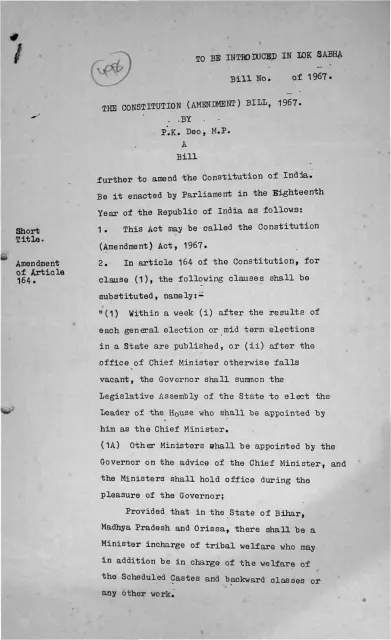
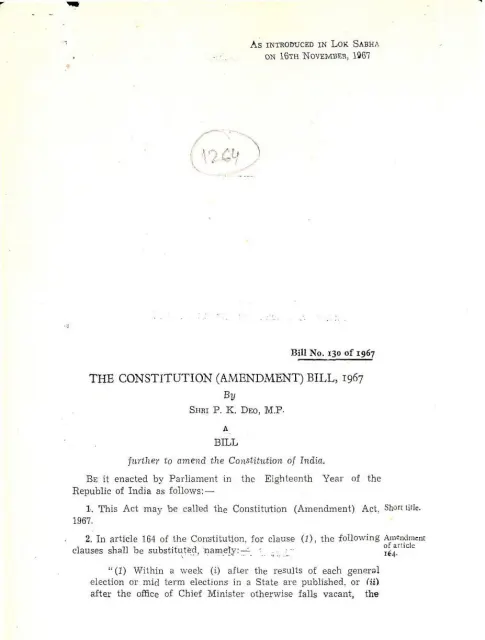
The Constitution (Amendment) Bill, 1967, introduced in the Lok Sabha by Shri P. K. Deo, M.P., proposes to amend Article 164 of the Constitution of India. Its central proposal is to establish a defined procedure for appointing a State Chief Minister: within a week of the publication of general or mid-term election results, or when the office becomes vacant, the Governor would summon the Legislative Assembly to elect the Leader of the House, who would then be appointed Chief Minister. The bill defines the Leader of the House as the member commanding an absolute majority, permitting a second or third ballot if necessary.
Key points
- The bill is identified as Bill No. 130 of 1967 and was introduced in the Lok Sabha on 16 November 1967.
- It proposes substituting a new clause in Article 164 concerning the appointment of State Chief Ministers.
- The Governor would summon the State Legislative Assembly to elect the Leader of the House within a specified period after an election or when the Chief Minister’s office falls vacant.
- The Leader of the House is defined as the person who commands the absolute majority of the House.
- The bill permits a second or third ballot where necessary to obtain an absolute majority.
- Other Ministers would be appointed by the Governor on the advice of the Chief Minister and would hold office during the Governor’s pleasure.
- In Bihar, Madhya Pradesh and Orissa, the bill provides for a Minister responsible for tribal welfare, with possible responsibility for Scheduled Castes and backward classes.
- The Statement of Objects and Reasons argues that the Constitution’s lack of a set appointment procedure has allowed Chief Ministers to be appointed without adequately reflecting the electorate’s verdict.
Metadata and summary are AI-extracted from the source PDF and reviewed for editorial accuracy. The original work is available via the Read PDF tab above (where present); paragraph-level citation inside the PDF is deferred to a future engagement.