reference
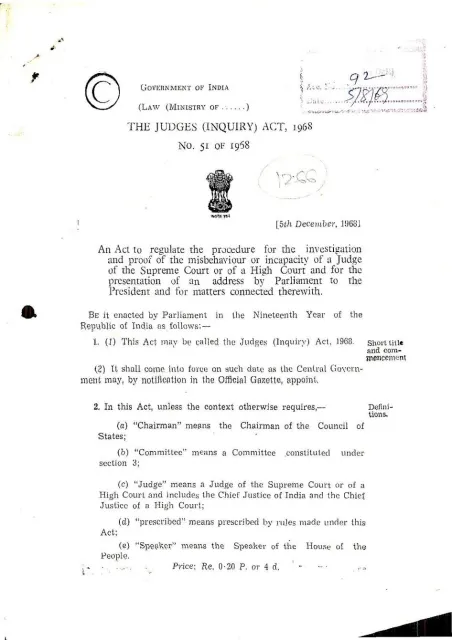
THE JUDGES (INQUIRY) ACT, 1968
GOVERNMENT OF INDIA (LAW (MINISTRY OF ......)) · 1968
7 pages
Summary
The Judges (Inquiry) Act, 1968, enacted as Act No. 51 of 1968 on 5 December 1968, establishes the parliamentary procedure for investigating alleged misbehaviour or incapacity of a Supreme Court or High Court judge and for presenting an address to the President seeking the judge’s removal. It defines key terms, including “Judge,” “Committee,” “Chairman,” and “Speaker,” and requires a removal motion to be initiated by at least 100 members of the Lok Sabha or 50 members of the Rajya Sabha.
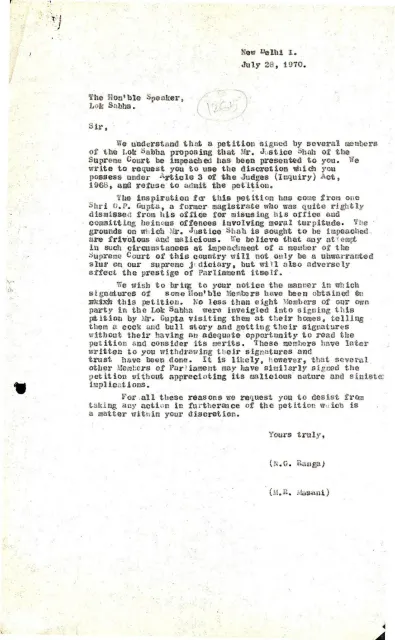
When a motion is admitted, the Speaker or Chairman constitutes a three-member investigating committee comprising a Supreme Court judge, a High Court Chief Justice, and a distinguished jurist. The Act provides for framing charges, communicating them to the judge, receiving a written defence, medical examination in incapacity cases, legal representation, and a fair opportunity to cross-examine witnesses and present evidence. The committee has specified powers of a civil court, submits its findings to Parliament, and the motion proceeds only if the committee finds misbehaviour or incapacity. The Act also provides for a fifteen-member Joint Committee of Parliament to make procedural rules. The final two rendered pages are a separately appended typed letter signed by N. G. Ranga and M. R. Masani concerning a proposed impeachment petition against Justice Shah; this letter is not part of the statutory text and its relationship to the Act is not explained in the document.
Key points
- The Act regulates investigation and proof of misbehaviour or incapacity of Supreme Court and High Court judges.
- A removal motion requires signatures from at least 100 Lok Sabha members or 50 Rajya Sabha members.
- An admitted motion triggers a three-member committee consisting of a Supreme Court judge, a High Court Chief Justice, and a distinguished jurist.
- The judge must receive formal charges and a reasonable opportunity to submit a written defence.
- The committee may arrange medical examination where incapacity is alleged and may appoint an advocate to conduct the case against the judge.
- The committee may exercise specified powers of a civil court, including summoning witnesses, requiring documents, receiving evidence on oath, and issuing commissions.
- A finding of no guilt or no incapacity ends further parliamentary proceedings; an adverse finding permits both Houses to consider the motion and, if adopted, present an address to the President.
- The appended letter alleges that signatures were improperly obtained for a petition seeking the impeachment of Justice Shah and asks the Lok Sabha Speaker to take no action.
Metadata and summary are AI-extracted from the source PDF and reviewed for editorial accuracy. The original work is available via the Read PDF tab above (where present); paragraph-level citation inside the PDF is deferred to a future engagement.