speech
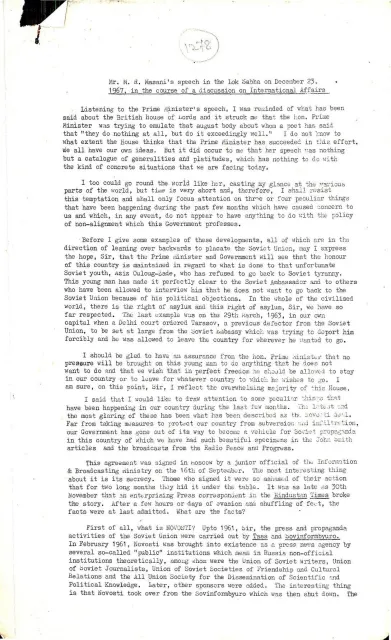
Mr. M. R. Masani's speech in the Lok Sabha on December 23, 1967, in the course of a discussion on International Affairs
By Minoo Masani
1967
5 pages
Summary
In this Lok Sabha speech, Minoo Masani argues that the government’s professed policy of non-alignment is being undermined by a series of concessions to the Soviet Union. He begins by criticizing the Prime Minister’s generalities and calls for attention to concrete cases, including the treatment of Soviet defector Aziz Ouloug-Zade and the government’s handling of Soviet propaganda and information agencies in India.
The central case is an agreement between India’s Press Information Bureau and Novosti, which Masani presents as granting a Soviet news organization access to Indian newspapers and periodicals. He contends that Novosti, Radio Peace and Progress, and Soviet official propaganda are institutionally connected, and challenges the government’s account of who authorized the agreement. He then broadens the argument to alleged official support for a pro-Soviet foreign-policy line, including the appointment of Mr. Dhawan and the Prime Minister’s visit to Moscow. The speech closes by warning that both Communist parties are moving toward an anti-democratic, insurrectionary position and endorsing Rajaji’s call to prevent them from exploiting constitutional democracy.
Key points
- Masani contrasts non-alignment as a declared policy with what he describes as a practical tilt toward the Soviet Union.
- He invokes the right of asylum while asking the government not to pressure Soviet defector Aziz Ouloug-Zade to return.
- He attacks the Novosti agreement and argues that it would facilitate the circulation of Soviet-produced material through India’s press system.
- He links Novosti with Radio Peace and Progress and portrays both as instruments of Soviet propaganda and official control.
- He questions which Indian officials authorized the agreement and calls for an investigation into the circumstances of its conclusion.
- He criticizes the appointment and activities of Mr. Dhawan, citing writings that he says demonstrate sympathy with Communist positions on Tibet and the Soviet Union.
- He argues that Moscow’s policy toward India has shifted under pressure from China and that India’s foreign policy must respond to this change.
- He concludes that the Communist parties should be barred from taking advantage of India’s democratic Constitution.
Metadata and summary are AI-extracted from the source PDF and reviewed for editorial accuracy. The original work is available via the Read PDF tab above (where present); paragraph-level citation inside the PDF is deferred to a future engagement.