letter
Letter to Prime Minister
By Atal Bihari Vajpayee, Minoo Masani, Piloo Mody
New Delhi · 1969
2 pages
Summary
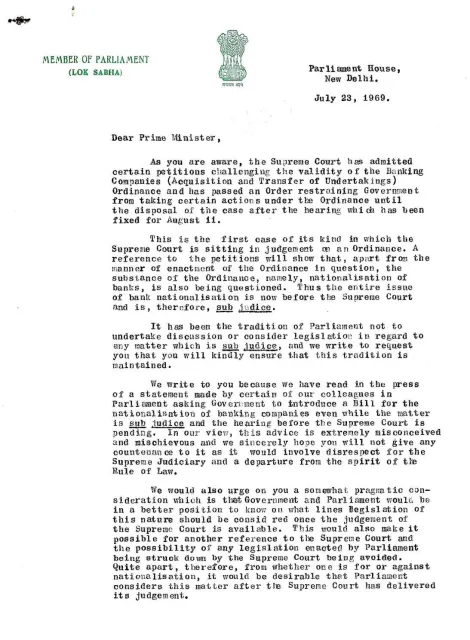
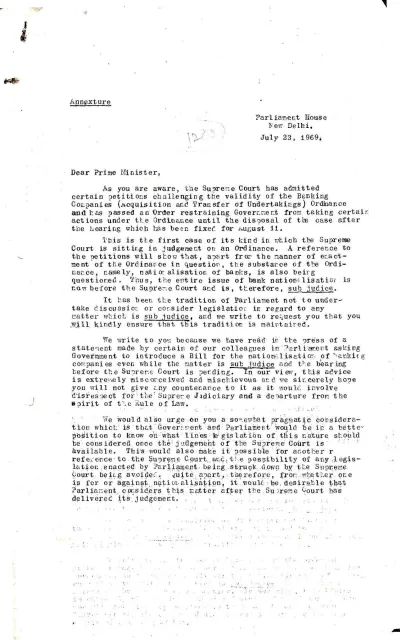
This two-page collective letter, dated Parliament House, New Delhi, July 23, 1969, is addressed to the Prime Minister in connection with the Banking Companies (Acquisition and Transfer of Undertakings) Ordinance. The signatories note that petitions challenging the Ordinance are before the Supreme Court and that the Court has restrained the Government from taking certain actions until its judgment, expected after an August 11 hearing.
The writers urge the Government and Parliament not to discuss or legislate on bank nationalisation while the matter is sub judice. They argue that parliamentary intervention would show disregard for the judiciary, risk legislation being struck down, and depart from the spirit of the rule of law. At the same time, they make a pragmatic case for waiting: once the Supreme Court has ruled, Parliament would have a clearer basis for deciding whether and how to proceed. The letter closes by noting that the Ordinance would remain valid for six weeks, leaving time for a Bill to be considered and passed after the judgment if the Government wished to do so.
Key points
- The letter concerns Supreme Court petitions challenging the Banking Companies (Acquisition and Transfer of Undertakings) Ordinance.
- The Supreme Court has issued an interim order restraining certain government actions under the Ordinance.
- The signatories invoke the parliamentary convention against discussing matters that are sub judice.
- They oppose calls to introduce a bank-nationalisation Bill while the case is pending before the Supreme Court.
- They characterize such legislative action as disrespectful to the judiciary and contrary to the rule of law.
- They recommend waiting for the Supreme Court’s judgment before deciding whether and how to legislate.
- The letter states that the Ordinance would remain valid for six weeks, allowing Parliament to act after the judgment.
Metadata and summary are AI-extracted from the source PDF and reviewed for editorial accuracy. The original work is available via the Read PDF tab above (where present); paragraph-level citation inside the PDF is deferred to a future engagement.