essay
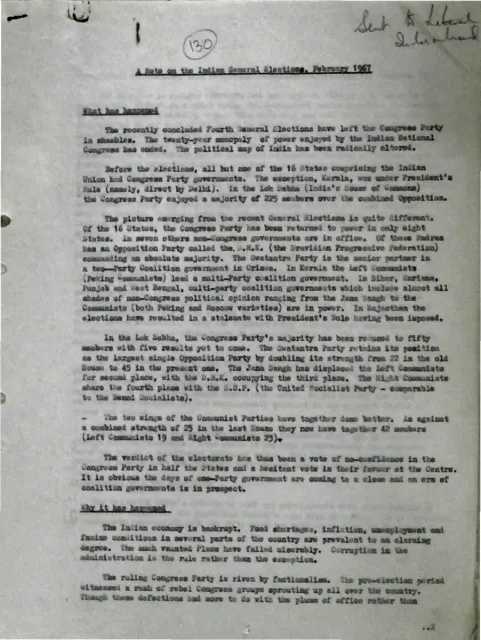
A Note on the Indian General Elections, February 1967
1967
3 pages
Summary
This three-page note examines the February 1967 general election as a decisive break with the Indian National Congress’s twenty-two-year monopoly of power. It reports that Congress returned to office in only eight of sixteen states, while coalition governments, opposition parties, and President’s Rule emerged elsewhere. In the Lok Sabha, Congress’s majority fell to fifty seats with five results still pending, while the Swatantra Party became the largest opposition party and the combined Communist parties increased their representation from 25 to 42 members.
The note attributes Congress’s losses to economic stagnation, food shortages, inflation, unemployment, administrative corruption, factionalism, and the electoral advantages produced by multi-cornered contests and opposition adjustments. It presents the election as potentially inaugurating a more balanced party system and strengthening parliamentary democracy. The Swatantra Party is described as a liberal-democratic, constitutionally minded party favouring a mixed economy rather than a socialist one, a non-denominational state, equal opportunity, and opposition to unconstitutional action. The note is cautiously optimistic about Swatantra’s future but stresses the difficulty of cooperation with the Jana Sangh because of disagreements over nationalism, secularism, language, Kashmir, relations with Pakistan, and the language question.
Key points
- The February 1967 election ended Congress’s twenty-two-year monopoly of political power.
- Congress retained power in only eight of India’s sixteen states, with coalition governments forming in several others.
- Congress’s Lok Sabha majority was reduced to fifty seats, while Swatantra became the largest opposition party.
- The note links Congress’s decline to economic hardship, inflation, unemployment, administrative corruption, and factionalism.
- Opposition coordination and the division of electoral contests helped parties win seats with minority vote shares.
- The election may produce a more balanced party system and give parliamentary democracy a meaningful alternative government.
- Swatantra is presented as liberal-democratic, constitutionalist, non-denominational, and committed to a mixed economy.
- Cooperation between Swatantra and the Jana Sangh is limited by deep disagreements on nationalism, secularism, Kashmir, Pakistan, and language.
Metadata and summary are AI-extracted from the source PDF and reviewed for editorial accuracy. The original work is available via the Read PDF tab above (where present); paragraph-level citation inside the PDF is deferred to a future engagement.