Summary
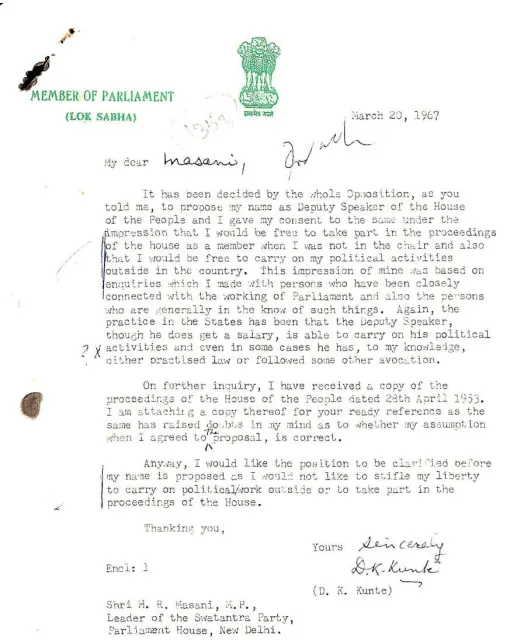
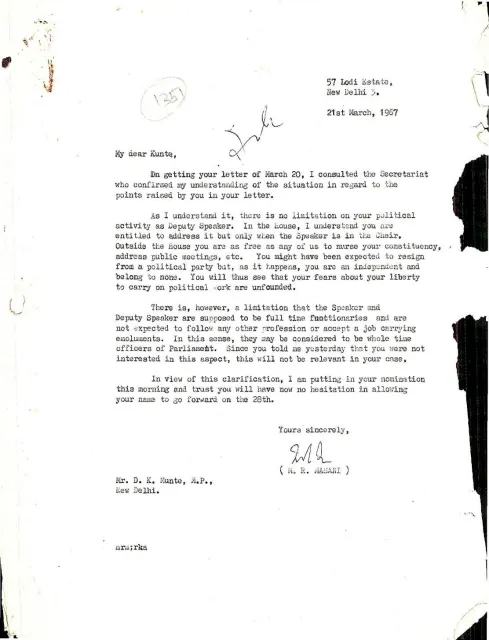
In this letter dated 21 March 1967, M. R. Masani responds to D. K. Kunte’s concerns about whether serving as Deputy Speaker restricts his political activity. Masani reports that he consulted the Secretariat and concludes that there is no limitation on Kunte’s political activity in that office. Kunte may address the House when the Speaker is in the Chair, and outside the House may act freely, including addressing public meetings and serving his constituency.
Masani distinguishes this political freedom from the separate expectation that the Speaker and Deputy Speaker serve as full-time parliamentary functionaries and do not take another profession or salaried job. Because Kunte had indicated that this latter issue was not relevant to his circumstances, Masani states that he is submitting Kunte’s nomination and asks him to allow his name to proceed on 28 March.
Key points
- Masani writes to D. K. Kunte on 21 March 1967 after consulting the Secretariat.
- He says that serving as Deputy Speaker does not limit Kunte’s political activity.
- Kunte may address the House when the Speaker is in the Chair and may address public meetings outside the House.
- As an independent member who belongs to no political party, Kunte would not need to resign from a party.
- The Deputy Speaker is expected to be a full-time parliamentary functionary and not to accept another salaried job or profession.
- Masani considers that full-time-service limitation irrelevant because of Kunte’s stated circumstances.
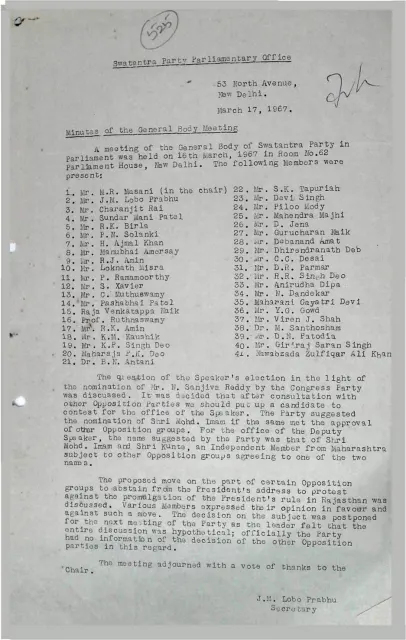
- Masani submits Kunte’s nomination and asks him to permit it to proceed on 28 March.
Metadata and summary are AI-extracted from the source PDF and reviewed for editorial accuracy. The original work is available via the Read PDF tab above (where present); paragraph-level citation inside the PDF is deferred to a future engagement.