Summary
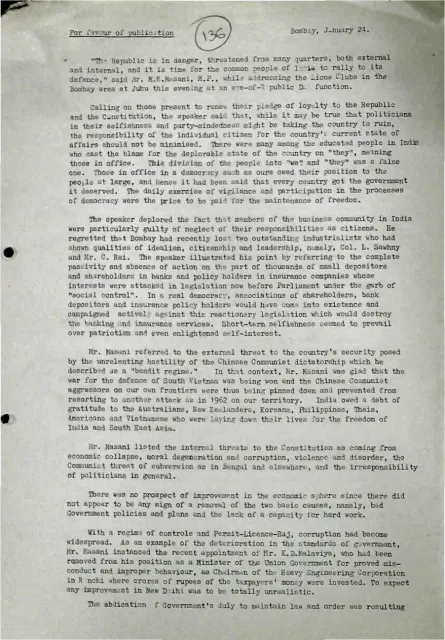
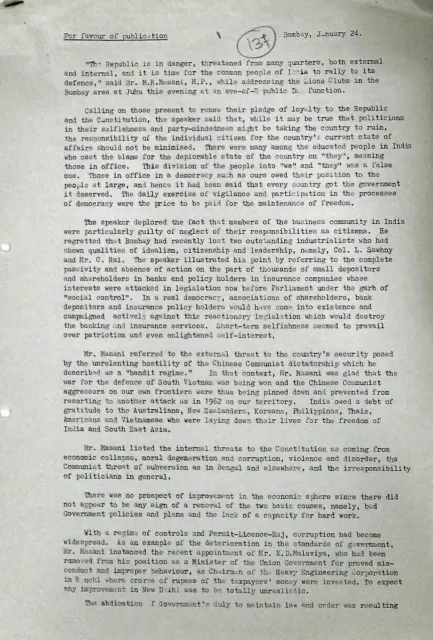
In this two-page press-publication note, M. R. Masani argues that India’s republic and Constitution are threatened by both external hostility and internal failures of citizenship, governance, and political responsibility. He calls on citizens to renew their loyalty to democratic institutions and rejects the tendency to blame the country’s condition solely on politicians: democratic vigilance and participation, he argues, are necessary to preserve freedom. He particularly criticizes businesspeople for failing to defend their civic interests, citing their passivity toward proposed legislation affecting banks and insurance companies and warning that short-term selfishness has displaced patriotism and enlightened self-interest.
Masani identifies external danger in the Chinese Communist dictatorship and internal dangers in economic collapse, moral degeneration, corruption, violence, disorder, Communist subversion, and irresponsible politicians. He attacks the Permit-Licence-Raj and alleged corruption in government, and contrasts voluntary democratic discipline with the imposed discipline of authoritarian regimes. He calls for a broad Government of Democratic Unity bringing together all viewpoints except the Communists, while insisting that citizens themselves must organize, accept responsibility, and help maintain order. The document is dated “Bombay, January 24.” but does not print a year, publisher, venue, or complete delivery date.
Key points
- Masani presents the republic and Constitution as endangered by external threats and internal political, economic, and social disorder.
- He argues that citizens, not only politicians, bear responsibility for the country’s condition and for sustaining democratic freedom.
- He criticizes the business community’s passivity toward legislation affecting banks, depositors, shareholders, and insurance policyholders.
- He attributes economic deterioration to bad government policies, inadequate planning, corruption, and the absence of a capacity for hard work.
- He links the Permit-Licence-Raj to widespread corruption and cites the appointment of K. D. Malaviya as an example of deteriorating governmental standards.
- He distinguishes voluntary democratic discipline from authoritarian and totalitarian discipline, warning that disorder can create a power vacuum.
- He advocates a Government of Democratic Unity excluding the Communists and urges ordinary citizens to form voluntary associations to maintain public order.
Metadata and summary are AI-extracted from the source PDF and reviewed for editorial accuracy. The original work is available via the Read PDF tab above (where present); paragraph-level citation inside the PDF is deferred to a future engagement.