speech · convention address
ECONOMIC DEVELOPMENT AND POLITICAL STABILITY
Poona · 1968
12 pages
Summary
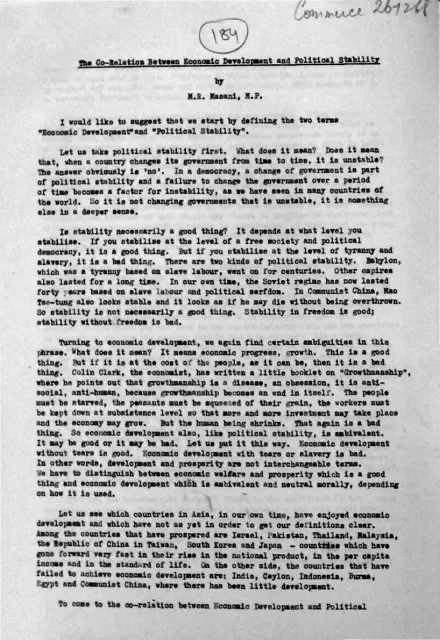
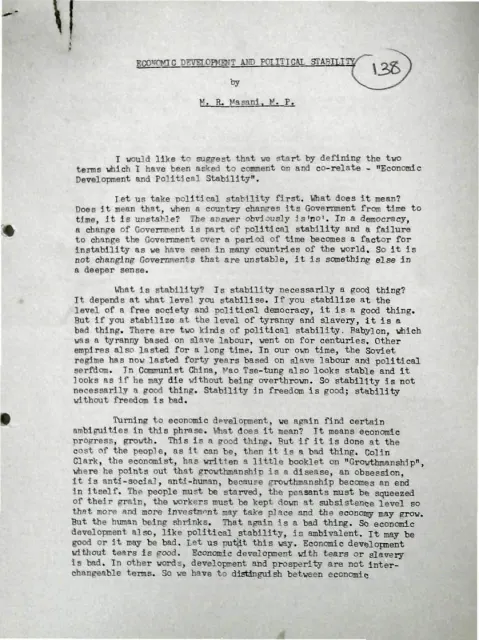
In this speech, M. R. Masani examines the relationship between economic development and political stability, beginning by challenging simple definitions of both terms. Political stability, he argues, is desirable only when grounded in freedom and democracy: stability under tyranny or slavery is not a social good. Economic development is similarly morally ambiguous. Growth that produces prosperity without tears is beneficial, but growth achieved through exploitation, coercion, or the impoverishment of workers and peasants is not. The speech rejects the idea that economic prosperity and political stability have a single, automatic causal relationship. Prosperity may generally support stability, but non-economic factors—including history, race, personality, emotion, language, and regional conflict—can be equally or more important.
Masani then turns to India’s economic record, citing stagnant per-capita income, foodgrain production, industrial output, and rising prices. He attributes this failure to State policy: excessive concentration on the public sector, statist planning, heavy-industry priorities, autarky, excessive taxation, deficit finance, and pervasive controls. The address concludes with a liberal programme that joins political freedom to competitive enterprise, consumer choice, private property—especially peasant ownership of land—and a limited State acting as an impartial referee. Masani presents Indian liberalism as drawing simultaneously on indigenous experience and Western liberal thinkers, and urges liberals to remain close to peasants and the middle class while translating liberal convictions into a mass political effort.
Key points
- Political stability is valuable only when it exists alongside freedom and democratic government.
- Economic development is morally dependent on how growth is achieved and distributed.
- The speech finds no simple two-way causal relationship between prosperity and political stability, while arguing that political stability is a precondition for sustained economic progress.
- India’s late-1950s and 1960s economic record is presented as one of stagnating living standards, weak foodgrain growth, inflation, and inadequate industrial performance.
- Masani blames statist planning, public-sector expansion, heavy-industry bias, autarky, taxation, deficit finance, and administrative controls for India’s economic difficulties.
- The proposed liberal alternative is a competitive economy with consumer choice, private property, peasant land ownership, and a State confined largely to impartial regulation and infrastructure.
- Indian liberalism is described as combining the legacy of Gandhi and earlier Indian liberals with the traditions of John Stuart Mill, Cobden, Bright, and Bentham.
Metadata and summary are AI-extracted from the source PDF and reviewed for editorial accuracy. The original work is available via the Read PDF tab above (where present); paragraph-level citation inside the PDF is deferred to a future engagement.