resolution
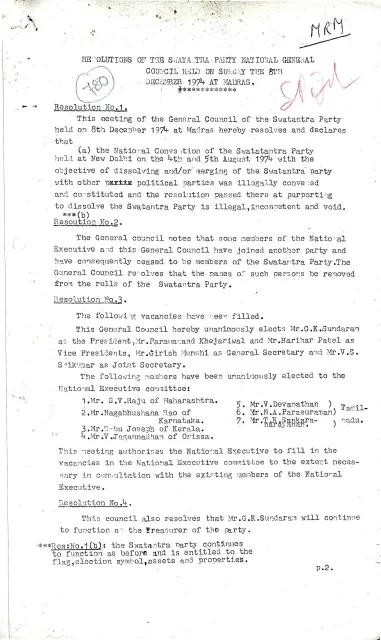
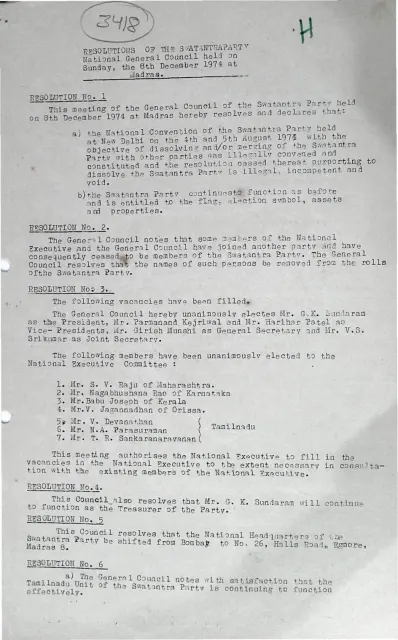
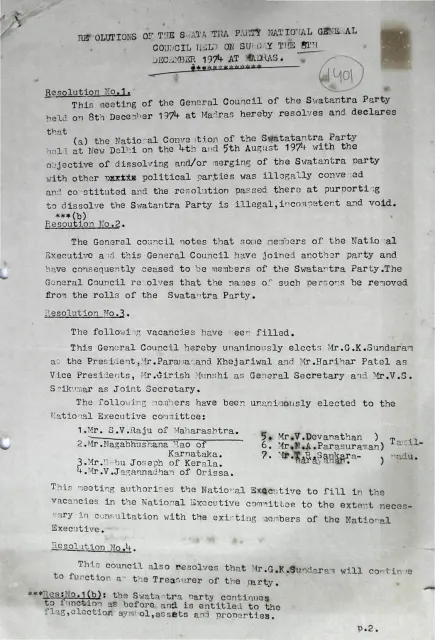
RESOLUTIONS OF THE SWATANTRA PARTY NATIONAL GENERAL COUNCIL HELD ON SUNDAY THE 8TH DECEMBER 1974 AT MADRAS.
Madras · 1974
2 pages
Summary
This two-page document records resolutions adopted by the Swatantra Party National General Council at Madras on 8 December 1974. The council rejects the earlier National Convention’s resolution proposing to dissolve or merge the party, declaring that resolution illegal, incompetent, and void. It also removes members who have joined another party, reconstitutes party offices and the National Executive, and affirms the party’s continuing institutional existence, including its flag, election symbol, assets, and properties.
The resolutions relocate the party’s national headquarters from Bombay to Madras, endorse the reorganisation of state units, and authorise measures to fill vacancies. They also support Jayaprakash Narayan’s movement to cleanse public life of corruption and nepotism, while criticising the ruling party’s 13-point programme as populist and insufficiently attentive to production and underlying economic problems. The document presents the Swatantra Party as seeking organisational continuity and political renewal rather than accepting its proposed dissolution.
Key points
- The General Council declares the August 1974 convention’s proposal to dissolve or merge the Swatantra Party illegal, incompetent, and void.
- Members who have joined another party are to be removed from the Swatantra Party’s rolls.
- G. K. Sundaram is elected president, with Paramanand Khejar… and Harinar Patel as vice presidents; A. Harish Munshi is named general secretary.
- The party headquarters is to move from Bombay to 26 Halls Road, Egmore, Madras.
- The council approves reorganisation and revitalisation of party units in Tamil Nadu, Orissa, Kerala, Maharashtra, Karnataka, and other states.
- The party endorses Jayaprakash Narayan’s anti-corruption and anti-nepotism movement and authorises coordination with it.
- The council criticises the ruling party’s 13-point programme for relying on populist distribution policies while neglecting production and broader economic problems.
Metadata and summary are AI-extracted from the source PDF and reviewed for editorial accuracy. The original work is available via the Read PDF tab above (where present); paragraph-level citation inside the PDF is deferred to a future engagement.