Summary
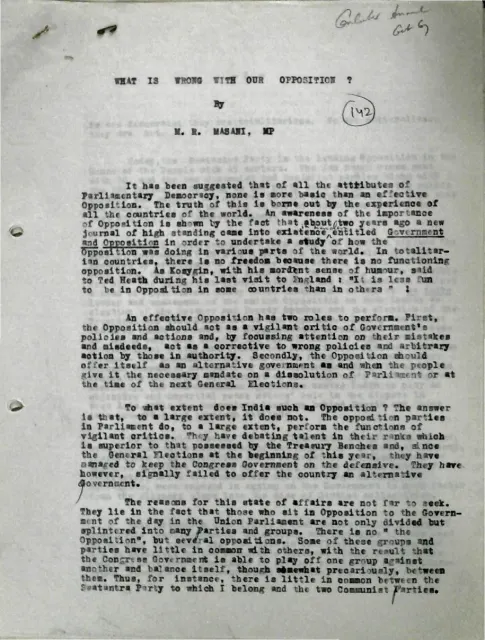
In the rendered pages, M. R. Masani argues that an effective opposition is a basic requirement of parliamentary democracy. He assigns it two functions: scrutinising government policy and conduct, and presenting itself as an alternative government capable of winning a public mandate. He contends that India’s opposition parties perform the first function to a considerable extent but have failed to offer a credible alternative to the Congress government.
In the rendered pages, Masani attributes this failure to fragmentation among opposition groups, whose ideological differences prevent the emergence of a durable United Opposition Front. He contrasts non-Communist parties’ positions on China, international affairs, and economic policy with those of the Communists, and presents the Swatantra Party as the principal defender of individual liberty, competitive free enterprise, and resistance to statist collectivism. The essay concludes, in the rendered pages, by calling for improved party organisation, disciplined cadres, and correction of deficiencies among party functionaries; the supplied scan includes printed pages 1, 2, and 4, with page 3 absent.
Key points
- Masani defines an effective opposition as both a critic of government and an alternative government.
- He argues that India’s opposition parties have demonstrated parliamentary debating ability but have not supplied a convincing alternative administration.
- Fragmentation and ideological disagreement prevent opposition parties from forming a stable United Opposition Front.
- The essay highlights disputes over China, international policy, and the West Asian conflict as sources of division between Communist and non-Communist parties.
- Masani presents the Swatantra Party as advocating individual liberty, competitive free enterprise, and rejection of statist collectivism.
- He attributes electoral disappointments partly to shortcomings in party organisation and the conduct of some functionaries.
- The essay calls for recruitment and training of a committed cadre of party workers.
Metadata and summary are AI-extracted from the source PDF and reviewed for editorial accuracy. The original work is available via the Read PDF tab above (where present); paragraph-level citation inside the PDF is deferred to a future engagement.