Summary
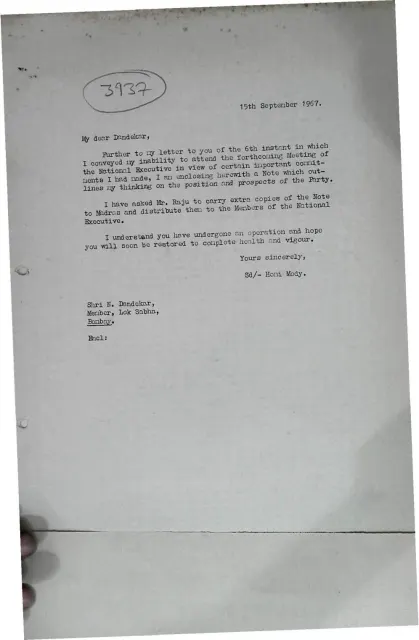
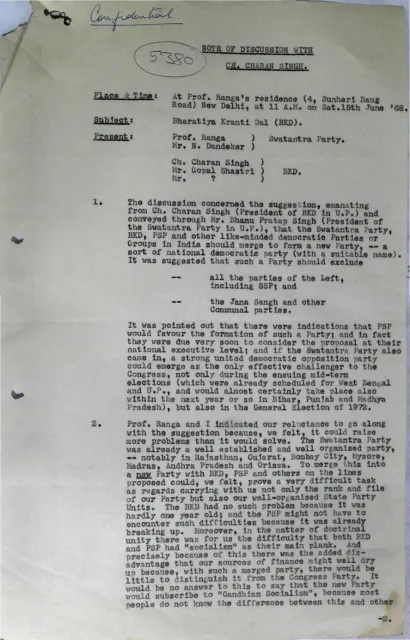
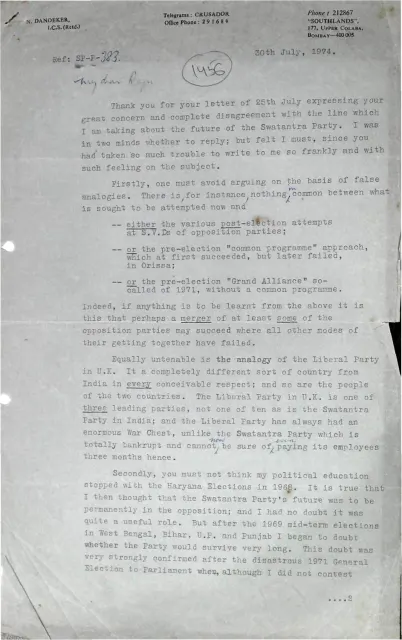
In this letter dated 30 July 1974, N. Dandekar responds to S. V. Raju’s disagreement with his proposed course for the future of the Swatantra Party. Dandekar rejects comparisons with post-election attempts by opposition parties, Odisha’s pre-election common programme, and the 1971 Grand Alliance, arguing that these precedents do not establish that a merger of opposition parties would fail. He also dismisses comparisons with the Liberal Party in the United Kingdom, emphasizing the radically different political and financial circumstances of India and Britain.
Dandekar explains that his doubts about the Swatantra Party’s survival grew after the 1969 state elections and were confirmed by the 1971 general election. Drawing on his experience of campaigning for Doshi, H. M. Patel, and Minoo Masani, and on the 1972 Matunga Assembly contest, he argues that opposition parties other than the Jan Sangh and Communists would be unable to survive unless they united as one party. He defends the use of expediency and opportunism when pursuing sound political objectives, acknowledges the Swatantra Party’s unfavourable public image, and says he will support Piloo Mody’s effort at the National Convention in Delhi, subject to his doctor’s permission.
Key points
- Dandekar rejects analogies between a proposed opposition-party merger and earlier coalition or alliance experiments.
- He argues that India’s political conditions differ fundamentally from those of the United Kingdom, making comparison with the British Liberal Party misleading.
- His assessment of the Swatantra Party became increasingly pessimistic after the 1969 elections and the 1971 general election.
- He presents opposition unity into one party as the only realistic route to political survival for most opposition parties.
- He defends expediency and opportunism as legitimate means when political objectives are sound and principled.
- He recognizes that the Swatantra Party remains associated in the public mind with maharajas, capitalists, landlords, and reactionaries.
- He rejects passivity and expresses support for Piloo Mody’s effort to reorganize the opposition.
Metadata and summary are AI-extracted from the source PDF and reviewed for editorial accuracy. The original work is available via the Read PDF tab above (where present); paragraph-level citation inside the PDF is deferred to a future engagement.