Summary
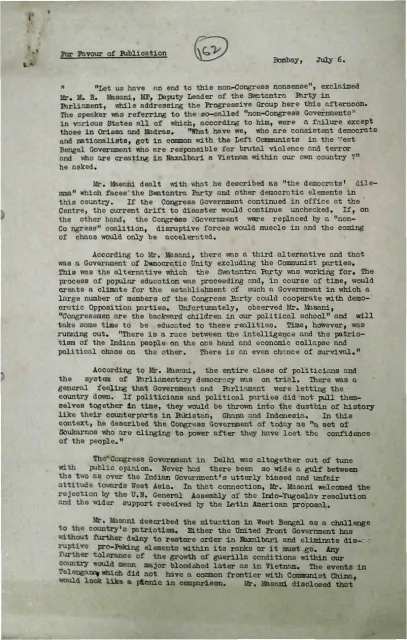
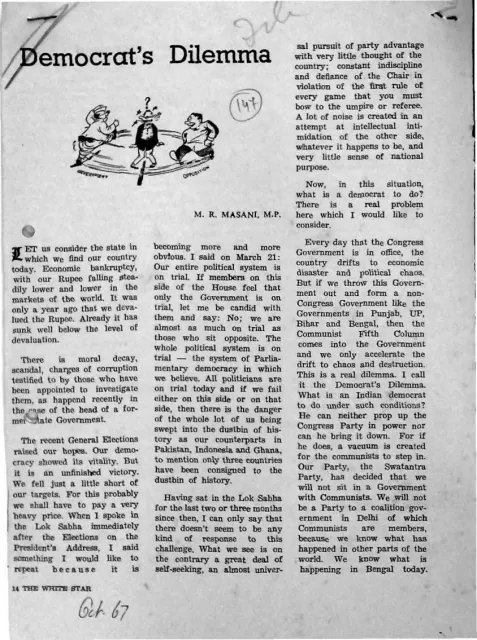
In the pages rendered, M. R. Masani presents India’s economic decline, corruption scandals, and unstable parliamentary politics as evidence that the democratic system itself is under trial. He argues that neither the Congress government nor a coalition including Communists offers a satisfactory answer: retaining Congress risks economic disaster, while replacing it with a Communist coalition could accelerate political chaos and create an opening for communism.
Masani’s proposed alternative is a “Government of Democratic Unity,” bringing together democratic forces across party lines while excluding Communists. He calls for political education, criticises both Congress and the opposition for partisan self-interest, and urges Congress members to abandon Nehru’s policies and form a new coalition government. Drawing on the examples of Pakistan, Ghana, and Indonesia, he warns that selfish politicians, loss of public confidence, and military intervention can destroy parliamentary democracy. He closes on an uncertain but hopeful note, saying democracy’s chances of survival are no better than fifty-fifty.
Key points
- Masani links economic decline, corruption, and political indiscipline to a broader crisis of parliamentary democracy.
- He describes both the Congress government and the opposition as being “on trial.”
- He rejects a Communist-inclusive coalition but also argues that Congress cannot simply remain in power unchanged.
- He proposes a Government of Democratic Unity composed of democratic parties and Congress dissidents.
- He advocates educating the public and Parliament about the dangers facing democratic government.
- He uses Pakistan, Ghana, and Indonesia as warnings about the consequences of political selfishness and declining public confidence.
- He concludes that democracy may survive, but that its prospects are highly uncertain.
Metadata and summary are AI-extracted from the source PDF and reviewed for editorial accuracy. The original work is available via the Read PDF tab above (where present); paragraph-level citation inside the PDF is deferred to a future engagement.