letter
Letter from Piloo Mody
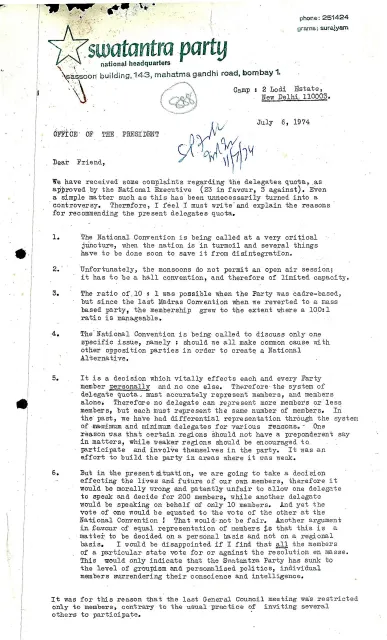
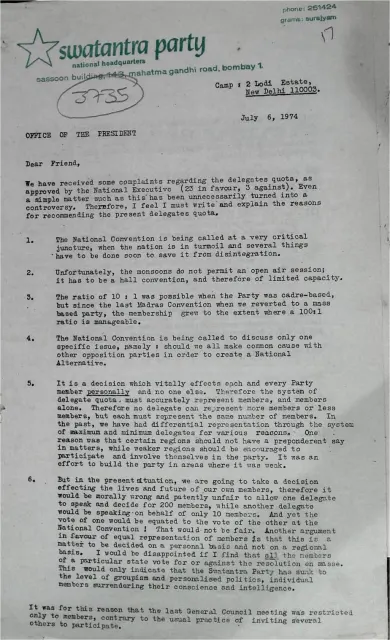
By Piloo Mody
swatantra party national headquarters · New Delhi · 1974
2 pages
Summary
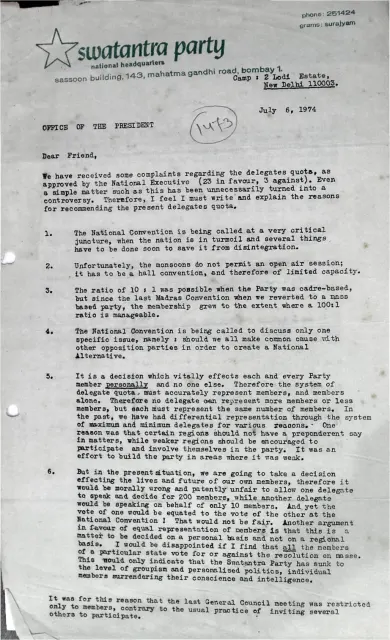
In this two-page letter dated July 6, 1974, Piloo Mody explains and defends the Swatantra Party’s delegates quota for its forthcoming National Convention. He argues that the convention is being held at a critical moment for the nation and the party, that monsoon conditions require a hall of limited capacity, and that the party’s growth from a cadre-based organisation makes the earlier 10:1 representation ratio impractical. He therefore supports a quota in which each delegate represents an equal number of members, within a total limit of 1,000 delegates.
Mody presents equal representation as essential because the convention will decide whether the party should make common cause with other opposition parties to create a national alternative. He warns that regional or state-based bloc voting would reduce members’ individual judgment to groupism and personalised politics. The letter closes by urging party unity, acceptance of the convention’s verdict, and prevention of a split that could undermine the objective of a two-party system.
Key points
- Mody defends the delegates quota approved by the National Executive by a vote of 23 to 3.
- The forthcoming National Convention is presented as urgent because the nation and the party are at a critical juncture.
- Monsoon conditions require an indoor convention with limited capacity.
- The party’s expansion from a cadre-based organisation makes a former 10:1 delegate ratio impractical; Mody argues that 100:1 is manageable.
- Each delegate should represent the same number of members rather than serving as a regional or state bloc representative.
- The convention will decide whether Swatantra should cooperate with other opposition parties to create a national alternative.
- Mody calls for party unity, acceptance of the convention’s decision, and avoidance of a split.
Metadata and summary are AI-extracted from the source PDF and reviewed for editorial accuracy. The original work is available via the Read PDF tab above (where present); paragraph-level citation inside the PDF is deferred to a future engagement.