Summary
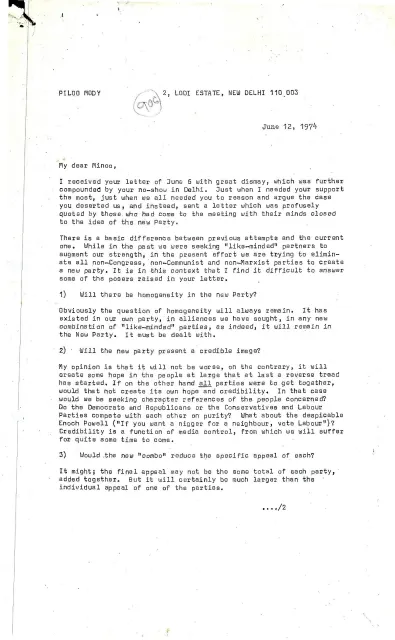
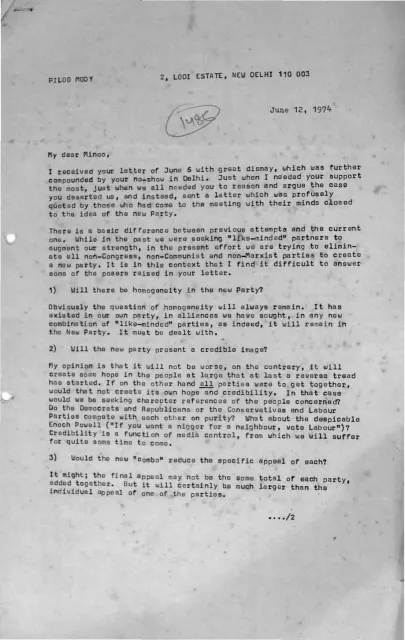
In this letter dated June 12, 1974, Piloo Mody urges Minoo Masani to reconsider his opposition to forming a new political party. Mody distinguishes the proposed alliance from earlier attempts to unite only “like-minded” groups: the new project would bring together all non-Congress, non-Communist, and non-Marxist parties. He acknowledges concerns about ideological homogeneity, public credibility, and the possibility that a coalition might dilute each constituent party’s distinctive appeal, but argues that these problems already exist within parties and alliances and must be managed rather than treated as reasons for inaction.
Mody argues that a new party could create public hope and credibility by ending the existing two-party obstruction between Congress and the Jan Sangh. He rejects the idea that a period of experimentation would necessarily produce constructive unity, warning instead that it could lead to prolonged quarrels, seat-sharing disputes, and efforts to build one party at the expense of its partners. The letter concludes with a direct appeal to Masani to “join the fray,” on the grounds that political circumstances will not wait.
Key points
- Mody presses Minoo Masani to support the formation of a new non-Congress, non-Communist, and non-Marxist party.
- He distinguishes the proposed alliance from earlier efforts based on ideological homogeneity or narrowly “like-minded” partners.
- He accepts that internal differences will remain but argues that coalition-building must proceed despite them.
- He contends that bringing the opposition parties together could generate public hope and political credibility.
- He warns that a loosely defined trial period could produce destructive disputes over seats and organisational advantage.
- He presents cooperation within the proposed “combo” as the test of whether opposition unity can move beyond past failures.
Metadata and summary are AI-extracted from the source PDF and reviewed for editorial accuracy. The original work is available via the Read PDF tab above (where present); paragraph-level citation inside the PDF is deferred to a future engagement.