Summary
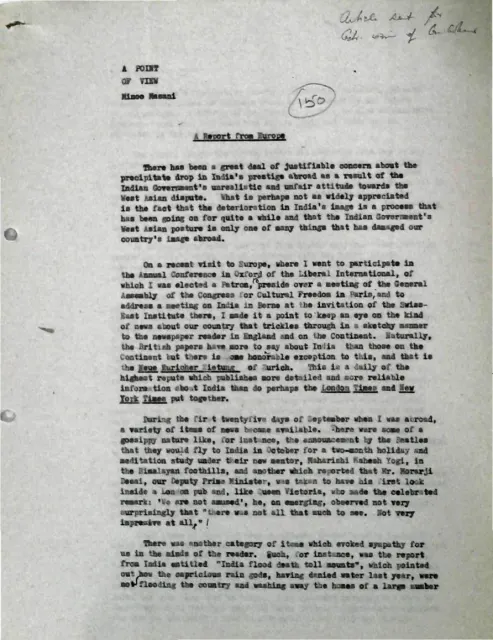
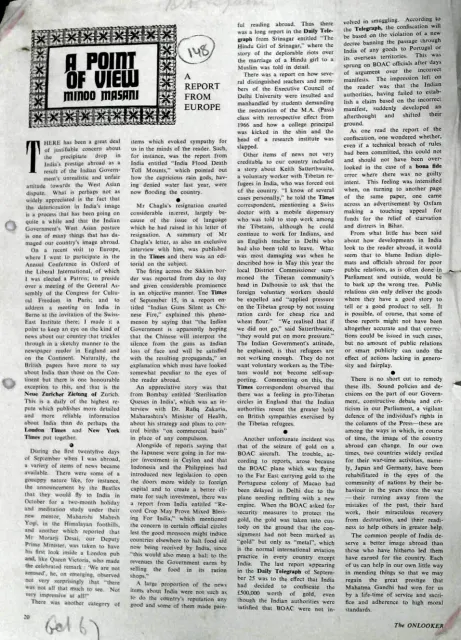
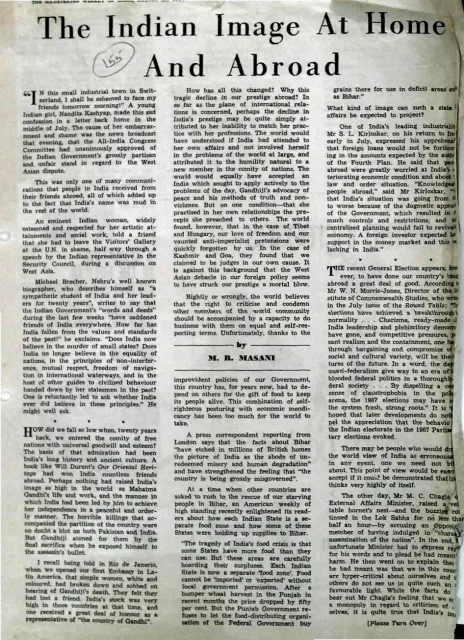
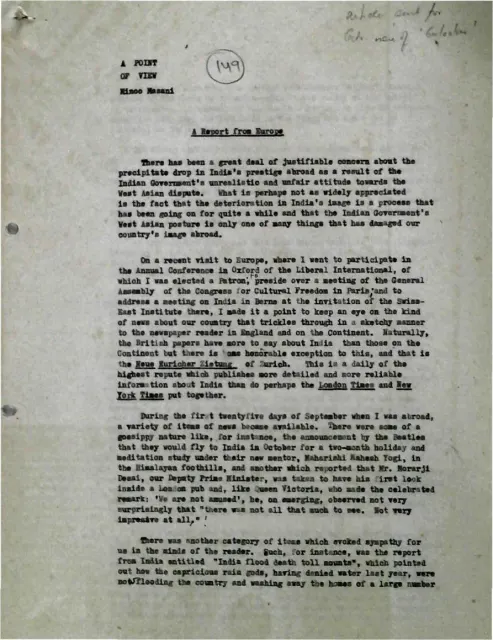
In this four-page report, Minoo Masani examines the deterioration of India’s image abroad, arguing that the problem extends beyond the government’s position on the West Asian dispute. Drawing on observations from a recent European visit and on reports in British and European newspapers, he catalogues stories about India involving communal violence, administrative arbitrariness, economic restrictions, population policy, university unrest, and official treatment of foreign aid and voluntary workers.
Masani argues that poor public relations cannot compensate for conduct that appears ungenerous, unfair, or inconsistent. He calls instead for sound government policies, constructive parliamentary criticism, vigilant protection of individual rights, and a readiness to acknowledge and correct mistakes. The report closes by holding out Japan and Germany’s post-war rehabilitation as examples of countries that improved their international standing through changed behaviour, and by urging Indians to restore the prestige associated with Mahatma Gandhi through service, sacrifice, and high moral standards.
Key points
- India’s declining reputation abroad is presented as the result of accumulated news and policy failures, not only its West Asian position.
- Masani reports that European newspapers offered readers a largely negative or unsympathetic picture of India.
- Examples include communal violence, the resignation of M. C. Chagla, border firing, coercive population-control proposals, and university disorder.
- The treatment of Tibetan refugee volunteers and the seizure of gold from a BOAC aircraft are used to illustrate perceptions of official arbitrariness.
- Masani argues that public relations cannot repair the damage caused by actions lacking generosity, fairness, or legal consistency.
- He recommends sound government decisions, parliamentary criticism, protection of individual rights, and correction of official mistakes.
- Japan and Germany are cited as examples of countries that rehabilitated their international reputations through changed conduct.
- The conclusion links national reputation to individual moral conduct and to the legacy of Mahatma Gandhi.
Metadata and summary are AI-extracted from the source PDF and reviewed for editorial accuracy. The original work is available via the Read PDF tab above (where present); paragraph-level citation inside the PDF is deferred to a future engagement.