periodical issue
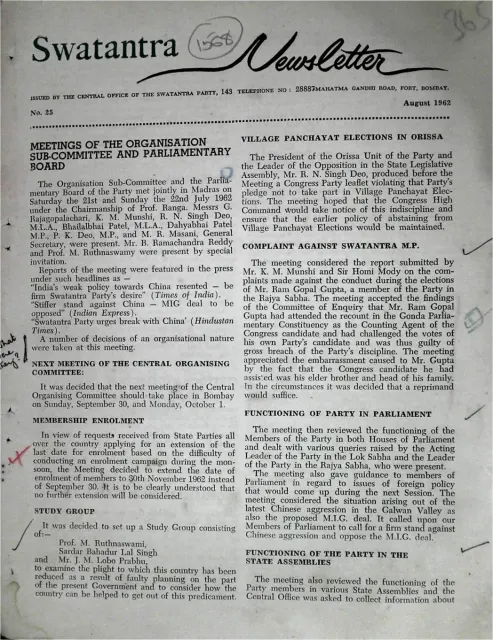
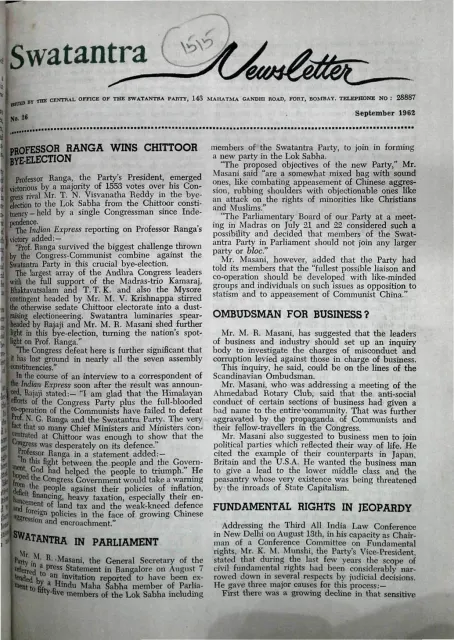
Swatantra Newsletter
ISSUED BY THE CENTRAL OFFICE OF THE SWATANTRA PARTY, 143 MAHATMA GANDHI ROAD, FORT, BOMBAY. TELEPHONE NO : 28887 · Bombay · 1962
6 pages
Summary
This September 1962 issue of the Swatantra Newsletter reports the party’s electoral performance, parliamentary strategy, policy arguments, and state-level organisation. It leads with Professor N. G. Ranga’s victory in the Chittoor Lok Sabha by-election, presents M. R. Masani’s case for cooperation among like-minded opposition groups, and records proposals concerning business ethics, fundamental rights, foreign policy, Chinese aggression, land revenue, and party administration. The issue’s political stance combines opposition to Congress economic policy and centralised planning with support for constitutional freedoms, independent trade unions, agrarian interests, and a more assertive foreign and defence policy.
Key points
- Professor N. G. Ranga’s Chittoor by-election victory is presented as a significant defeat for the Congress-Communist combine and evidence of Swatantra’s growing electoral importance.
- M. R. Masani argues for cooperation among like-minded groups while opposing formal merger or bloc membership with larger parties.
- The issue advocates a business-led inquiry body modelled on the Scandinavian Ombudsman to investigate misconduct and corruption in commerce and industry.
- K. M. Munshi warns that judicial decisions have narrowed the scope of fundamental rights and identifies constitutional, legal, and ideological causes for that decline.
- The newsletter attacks non-alignment as insufficiently responsive to Chinese aggression and reproduces a four-point proposal involving diplomatic isolation, internal security, defence leadership, and military alliances.
- State reports describe opposition to increased land revenue in Andhra Pradesh, party mobilisation in several regions, and the formation of a United Opposition Front in Punjab.
- The closing policy extracts reject centralised, top-heavy planning while defending constitutional freedom, food self-sufficiency, and independent worker-controlled trade unions.
Metadata and summary are AI-extracted from the source PDF and reviewed for editorial accuracy. The original work is available via the Read PDF tab above (where present); paragraph-level citation inside the PDF is deferred to a future engagement.