Summary
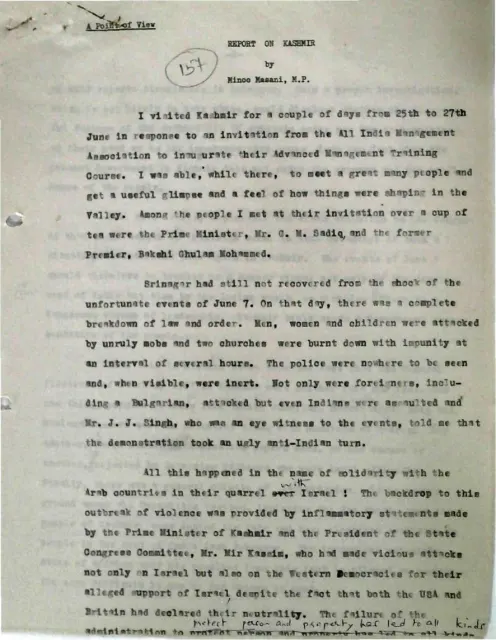
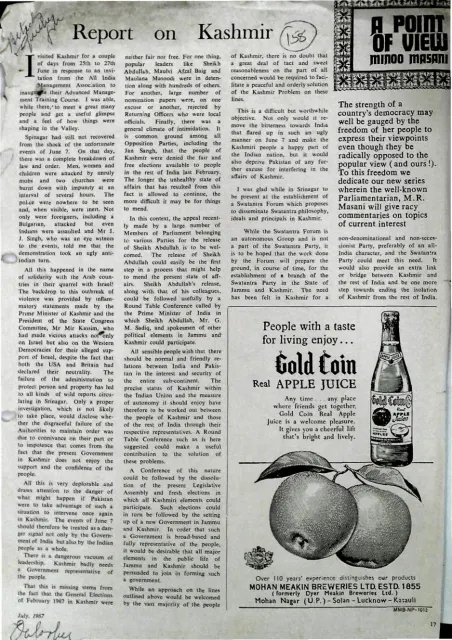
In the rendered pages, Minoo Masani reports on a June 1967 visit to Kashmir following the violence of June 7. He describes a breakdown of law and order, attacks on civilians and religious sites, intimidation of officials, and the absence of effective political leadership. He criticizes the administration’s failure to investigate the violence and argues that the unrest should be treated as a danger to both the Government of India and the Indian people, rather than only as a local or communal dispute.
In the rendered pages, Masani advocates a political settlement based on representative government, civil liberties, and improved relations between India and Pakistan. He supports the release of Sheikh Abdullah and proposes a Round Table Conference involving Kashmiri representatives and political elements from Jammu and Kashmir, followed by the dissolution of the existing Legislative Assembly, fresh elections, and the formation of a broadly representative government. He also describes the Forum of Free Enterprise’s proposed Swatantra Forum as an autonomous, non-sectarian effort to disseminate Swatantra philosophy in Kashmir, while insisting that Kashmir’s status and autonomy should be worked out between its people and their representatives and the rest of India.
Key points
- Masani’s report follows a June 1967 visit to Srinagar after the violence of June 7.
- He records attacks on men, women, children, mosques, and churches, alongside a failure of the authorities to maintain order.
- He attributes the continuing crisis partly to inflammatory political statements and an absence of representative leadership.
- He warns that Pakistan could exploit the situation and intervene again in Kashmir.
- He calls for the release of Sheikh Abdullah and a Round Table Conference involving Kashmiri and wider Indian political representatives.
- He proposes dissolving the existing Legislative Assembly, holding fresh elections, and establishing a broadly representative government.
- He argues for normal and friendly India-Pakistan relations and for Kashmir’s status and autonomy to be settled through representative political processes.
- He reports on the proposed Swatantra Forum as a non-sectarian vehicle for disseminating Swatantra ideas in Kashmir.
Metadata and summary are AI-extracted from the source PDF and reviewed for editorial accuracy. The original work is available via the Read PDF tab above (where present); paragraph-level citation inside the PDF is deferred to a future engagement.