report · report
General Secretary’s Report
THE SWATANTRA PARTY · Bhubaneswar · 1968
33 pages
Summary
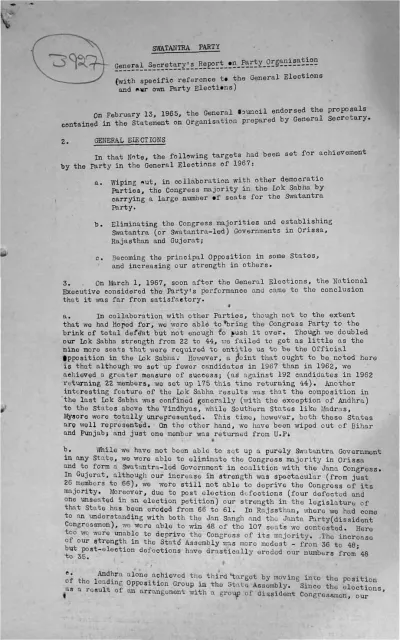
The Swatantra Party’s General Secretary’s Report to its Fifth National Convention in Bhubaneswar (October 5–6, 1968) reviews party activity since the Fourth National Convention in December 1966. In the rendered pages, it recounts the adoption of the 1967 election manifesto, the party’s electoral performance, organisational elections, meetings of the General Council and National Executive, and the work of the Central Parliamentary Board. The report is presented as a largely factual account, while acknowledging that the party’s 1967 performance fell well short of its stated targets.
In the rendered pages, the report records the party’s increase from 22 to 44 Lok Sabha members, its coalition government in Orissa, its gains in Gujarat and Rajasthan, and its failure to become the principal opposition in several states. It attributes shortcomings to candidate selection, weak electoral understandings, poor management, overextended leadership, and the absence of a disciplined cadre. The report also describes extensive publicity efforts, internal elections and membership growth, disciplinary action against legislators, opposition to communist participation in government, criticism of bank and insurance nationalisation and state economic controls, and concerns about constitutional rights, press legislation, judicial independence, and parliamentary conduct. The final rendered page begins the report’s account of the Central Parliamentary Board; subsequent sections are not visible.
Key points
- The report covers party activity between the Fourth National Convention in December 1966 and the Fifth Convention in October 1968.
- The party adopted an election manifesto and set ambitious targets for defeating or reducing Congress dominance in Parliament and the states.
- The 1967 election increased Swatantra’s Lok Sabha representation from 22 to 44 members, but the party missed several organisational and electoral objectives.
- The report candidly identifies weak candidate selection, inadequate alliances, poor management, leadership burdens, and insufficient party organisation as causes of electoral failure.
- The Central Office conducted a large multilingual publicity campaign involving newspapers, films, posters, pamphlets, manifesto distribution, recordings, and other materials.
- Party elections expanded the organisation substantially and brought many newcomers into state and national committees.
- The National Executive defended party independence from unstable United Front governments, opposed communist participation in government, and stressed cadre-building and work among farmers.
- The report links parliamentary opposition to economic nationalisation and planning measures with concerns about constitutional rights, judicial authority, press freedom, and the rule of law.
Metadata and summary are AI-extracted from the source PDF and reviewed for editorial accuracy. The original work is available via the Read PDF tab above (where present); paragraph-level citation inside the PDF is deferred to a future engagement.