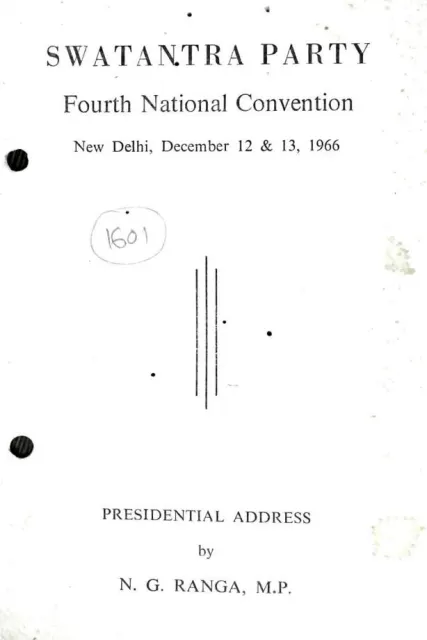
speech · convention address
PRESIDENTIAL ADDRESS
SWATANTRA PARTY · New Delhi · 1966
17 pages
Summary
In this Presidential Address to the Swatantra Party’s Fourth National Convention in New Delhi, N. G. Ranga presents the Congress government as politically exhausted, economically interventionist, and increasingly hostile to democratic freedoms. He links the November 1966 disturbances outside Parliament and the Bastar killings to a broader loss of public confidence. The address condemns the License, Permit and Quota Raj, restrictions on land ownership, compulsory and cooperative farming, ceiling laws, currency devaluation, deficit financing, and state controls that, in his view, have weakened peasant proprietorship, self-employment, and economic incentives. Ranga also cites student strikes and police firings as evidence of growing alienation from Congress rule.
Ranga frames the Swatantra Party as a democratic, Gandhian alternative to both Congress statism and communist-style planning. He defends Fundamental Rights, private ownership, peasant and artisan autonomy, and a more limited and accountable government. The address calls for electoral cooperation among non-Congress parties, the formation of coalition or united-front ministries, stronger State autonomy within India’s federal system, and replacement of the Planning Commission with a democratic advisory council. It concludes with proposals for independent quasi-judicial commissions, an Ombudsman, reduced ministerial discretion, and clean and efficient administration, while urging peasants and other voters to defeat Congress in the forthcoming elections.
Key points
- The address attributes declining public confidence in Congress to political instability, corruption, administrative failure, and violence.
- It attacks the License, Permit and Quota Raj, land ceilings, cooperative farming, and other controls as threats to property rights and occupational freedom.
- Ranga treats inflation, devaluation, food shortages, and dependence on food imports as consequences of misguided economic management.
- Student strikes, demonstrations, and police firings are presented as signs of widening alienation between young people and Congress ministries.
- The Swatantra Party is presented as a Gandhian and democratic alternative to Congress statism and communist-style planning.
- The speech advocates electoral coordination among Swatantra, Jana Congress, Jan Sangh, and other democratic parties to prevent Congress majorities.
- Ranga proposes greater State autonomy, a broad-based National Council, independent administrative commissions, and an Ombudsman.
- Peasant mobilisation and defence of land ownership are identified as central to the party’s political programme.
Metadata and summary are AI-extracted from the source PDF and reviewed for editorial accuracy. The original work is available via the Read PDF tab above (where present); paragraph-level citation inside the PDF is deferred to a future engagement.