pamphlet
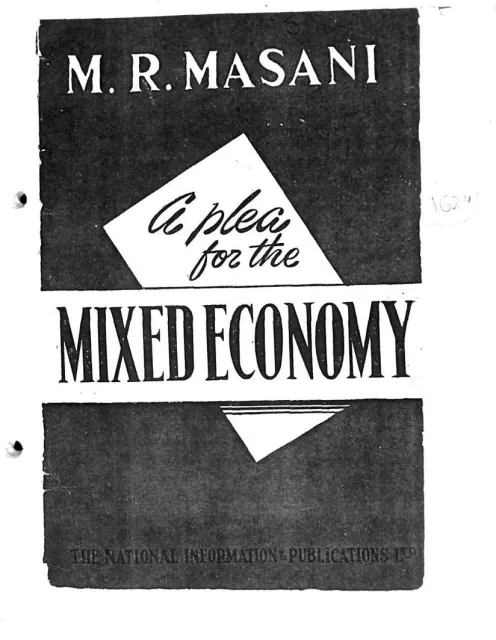
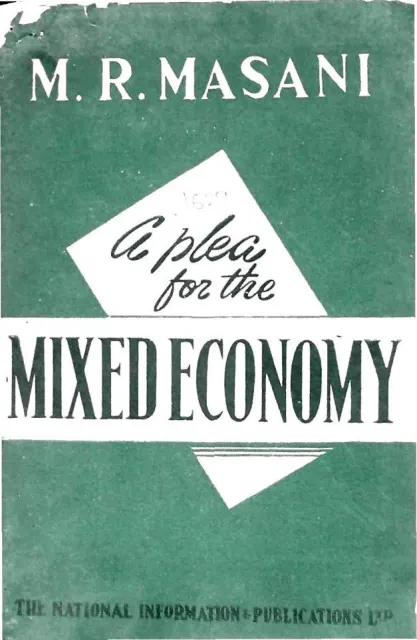
A Plea for the Mixed Economy
By Minoo Masani
THE NATIONAL INFORMATION & PUBLICATIONS LTD., BOMBAY · BOMBAY · 1947
40 pages
Summary
In the rendered pages, M. R. Masani argues that India’s immediate economic priority is increased production. He opens by comparing India’s low industrial output with that of countries such as the United Kingdom, the United States, Belgium, Sweden, France, Italy, and Germany, then documents post-war declines in steel, electricity, cloth, coal, and foodgrain production alongside rapid population growth, inflation, and falling living standards. Masani accepts that production must be accompanied by equitable distribution, but insists that distribution cannot substitute for creating greater national wealth.
In the rendered pages, Masani develops a case against indiscriminate nationalisation and for a mixed economy combining limited state ownership, new public enterprises, and a much larger free-enterprise sector. He distinguishes state control from state ownership and management, warns that bureaucratic management can hinder industrialisation, and recommends that public corporations enjoy substantial autonomy while remaining politically accountable. The proposed system also includes worker participation, industrial democracy, decentralisation associated with Mahatma Gandhi, and controls designed to protect the community without stifling initiative. The pages visible here end after Masani outlines three industrial sectors and begins his comparison of free enterprise with a fully nationalised economy; the pamphlet’s remaining pages were not rendered.
Key points
- India’s most pressing economic need, as argued in the rendered pages, is increased production rather than immediate equalisation of incomes.
- Masani uses comparative statistics on steel, electricity, cloth, coal, foodgrains, and national income to portray India as being near the beginning of its industrial revolution.
- He argues that equitable distribution requires increased purchasing power among working people, which in turn depends on higher production.
- The rendered pages distinguish nationalisation as a broad concept of national control from state ownership and management of industries.
- Masani rejects an a priori policy of nationalising all basic or key industries and limits nationalisation to exceptional cases supported by public investigation.
- He proposes three sectors: a small group of exceptionally nationalised industries, new public enterprises where private enterprise cannot meet national needs, and a dominant free-enterprise sector.
- The mixed economy should combine regulation, public accountability, industrial democracy, worker participation, and sufficient autonomy for enterprise.
- Masani presents the mixed economy as a practical alternative to both unrestricted laissez-faire and comprehensive state control.
Metadata and summary are AI-extracted from the source PDF and reviewed for editorial accuracy. The original work is available via the Read PDF tab above (where present); paragraph-level citation inside the PDF is deferred to a future engagement.