Summary
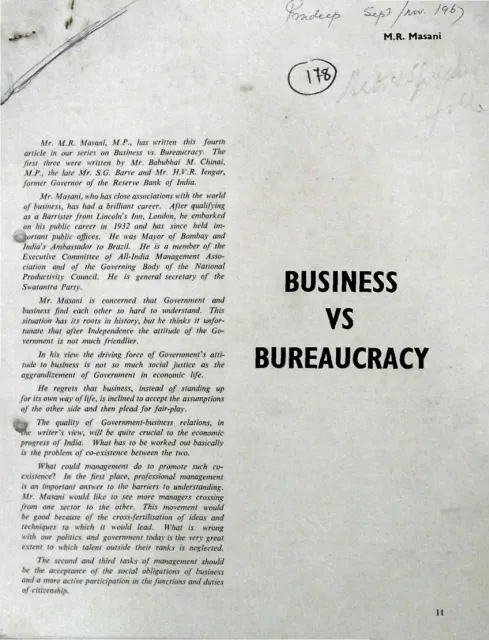
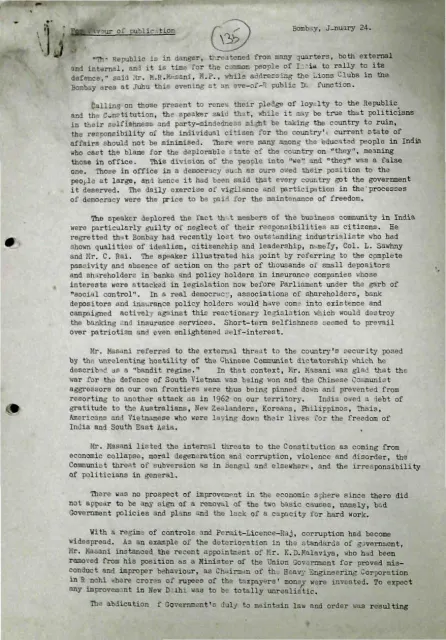
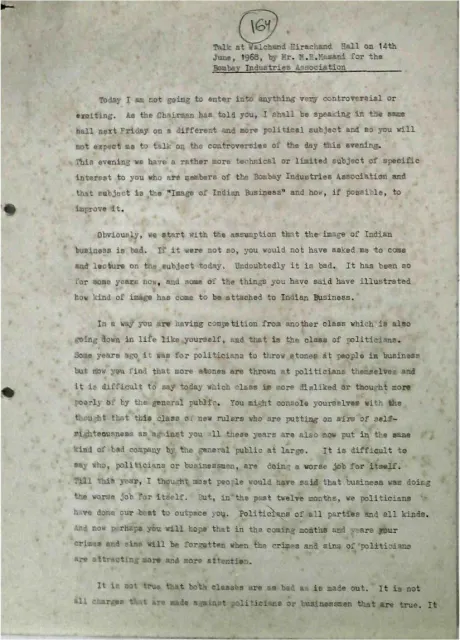
In this talk to the Bombay Industries Association, Minoo Masani examines the damaged public image of Indian business and the strained relationship between business and government. He rejects the older moral contrast between supposedly virtuous politicians and supposedly selfish businessmen, arguing that both groups contain good and bad actors and that public dissatisfaction reflects unmet expectations in a low-income, rapidly changing society. He also criticises the inherited antagonism of the British Raj toward Indian industry, drawing on the treatment of J. N. Tata and the Tata Fertiliser Project to argue that postcolonial governments have repeated earlier efforts to restrain industrial development. Masani links this hostility to socialism, envy, state control, and the emergence of a “new class” comprising politicians, bureaucrats, and businessmen who may collaborate in exploiting the country.
The second half of the speech focuses on public relations, lobbying, and corporate social responsibility. Masani argues that public relations cannot conceal unethical or unsuccessful business practices: companies must first become good citizens and then communicate their record effectively. He urges businesses to counter unjust criticism actively rather than retreat from public affairs, comparing several possible approaches, including trade associations, professional lobbyists, corporate public-relations departments, and direct leadership by chief executives. The talk closes by calling for managers to be trained not only in management but also in democratic citizenship and public leadership, citing the Leslie Sawhny Programme of Training for Democracy as one possible institutional response.
Key points
- Masani treats the poor public image of Indian business as a problem of communication, conduct, and public responsibility.
- He argues that politicians and businessmen alike are flawed and should not divide themselves into mutually hostile classes.
- The speech attributes persistent government-business antagonism partly to the legacy of British policy toward Indian industry.
- Masani criticises socialism and state intervention when they become vehicles for envy, bureaucratic control, or hostility to profit and private enterprise.
- He calls for active, professional lobbying and public relations rather than business timidity or reliance solely on chambers of commerce.
- He insists that public relations cannot manufacture a good reputation where a company’s conduct is genuinely bad.
- The speech advocates training business executives as democratic citizens and public leaders, not merely as managers.
Metadata and summary are AI-extracted from the source PDF and reviewed for editorial accuracy. The original work is available via the Read PDF tab above (where present); paragraph-level citation inside the PDF is deferred to a future engagement.