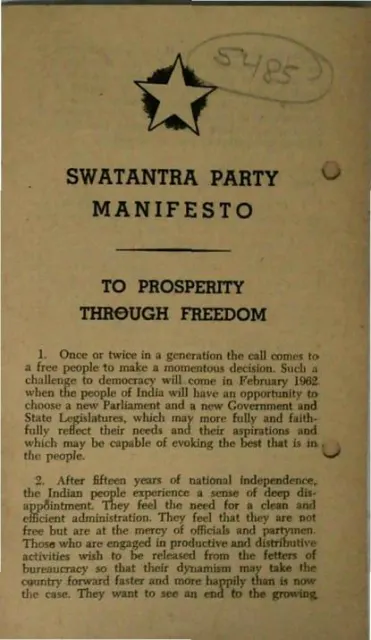
programme · manifesto
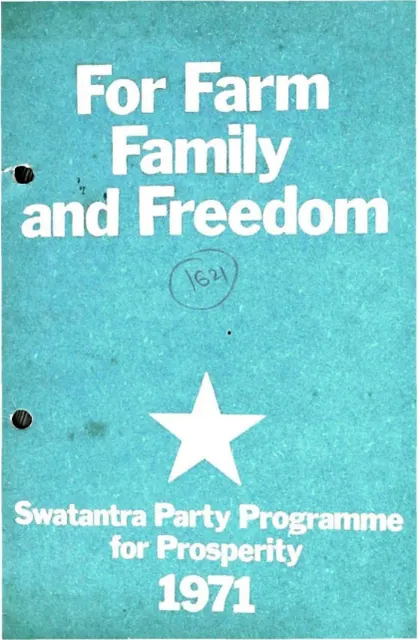
For Farm Family and Freedom
Published by S. V. Raju, for the Swatantra Party, National Headquarters, 143 Mahatma Gandhi Road, Bombay 1 and printed by him at Inland Printers, 55 Gamdevi Road, Bombay 7 · Bombay · 1971
17 pages
Summary
For Farm Family and Freedom is the Swatantra Party’s 1971 election manifesto. Part I presents the party’s programme as a defence of constitutional democracy, Fundamental Rights, judicial independence, law and order, and private property. It condemns inflation, deficit finance, administrative waste, excessive planning, and restrictions on economic activity, while proposing employment-generating public works, rural housing and infrastructure, support for family farming, secure tenancy, fair agricultural prices, and incentives for production and enterprise.
The manifesto combines market-oriented economic proposals with targeted social measures. It calls for protection of minorities and backward classes, equality of opportunity, a Commission on Civil Rights, improved education, anti-corruption institutions, and assistance for poorer groups. It also advocates competition, greater autonomy for public-sector enterprises, a stable currency, controlled and productive use of foreign capital, and a restrained but firm regulatory role for government. Its conclusion frames the 1971 election as a choice between constitutional liberty and what it describes as the ruling Congress government’s attacks on democratic institutions and failed economic policies.
Part II reproduces a June 28, 1970 All India Congress Committee document, “The Political Crisis,” followed by Congress positions on national unity and security, constitutional liberties, minorities, employment, agriculture, industry and trade, education, corruption, foreign aid, and labour. The two parts overlap substantially on employment, agricultural development, constitutional liberties, and equality, but Part II presents these priorities as a Congress programme and places greater emphasis on national unity, social justice, public-sector efficiency, and the Directive Principles of the Constitution.
Key points
- The Swatantra Party presents constitutional protection, Fundamental Rights, and judicial independence as prerequisites for stable democracy.
- The manifesto links unemployment and poverty to faulty planning and proposes large-scale public works, rural infrastructure, housing, and employment programmes.
- It defends peasant ownership and family farming while supporting land reform, secure tenancy, fair rents, minimum wages, crop insurance, and better agricultural markets.
- Its economic programme favours a stable currency, reduced inflation, competition, fewer licences and permits, lower red tape, and incentives for private production and enterprise.
- The document calls for legal and institutional protection for minorities, Scheduled Castes, Scheduled Tribes, and other backward sections, including a Commission on Civil Rights.
- It proposes education reform, Lokpal and Lok Ayukta institutions, accountable administration, controlled foreign borrowing, and selective foreign equity investment.
- Part II reproduces a Congress document that addresses political instability, national unity, constitutional liberties, employment, agriculture, industry, education, corruption, foreign aid, and labour.
Metadata and summary are AI-extracted from the source PDF and reviewed for editorial accuracy. The original work is available via the Read PDF tab above (where present); paragraph-level citation inside the PDF is deferred to a future engagement.