
essay · annual report
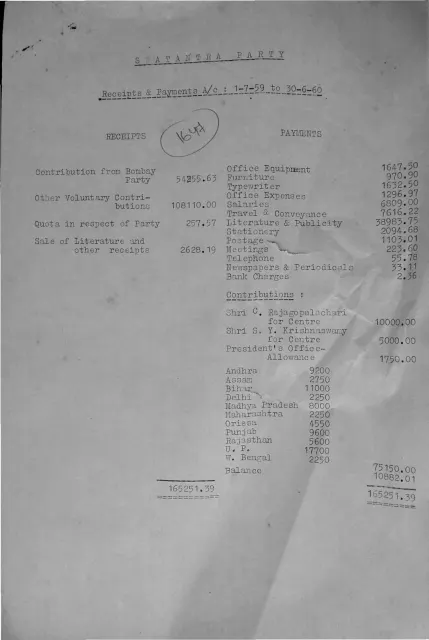
Receipts & Payments A/c.: 1-7-59 to 30-6-60
SWATANTRA PARTY · Bombay · 1960
11 pages
Summary
This Swatantra Party office document combines the party’s receipts-and-payments account for 1 July 1959 to 30 June 1960 with a background note prepared for an Anti-Inflation Day. The financial statement records total receipts and payments of Rs. 165,251.39. Major receipts include voluntary contributions, especially from the Bombay Party and other contributors; listed payments include literature and publicity, salaries, travel, office expenses, and contributions to the party’s central office. The account also records state-unit contributions and a closing balance of Rs. 10,882.01.
The attached talking points argue that inflation is not merely a monetary or price problem but a threat to democratic freedom, private enterprise, savings, capital formation, and economic development. Extracts attributed to Graham Hutton present inflation as leading governments toward taxation, controls, compulsory wage policies, and expanding bureaucracy. Additional material from an IMF mission report and Reserve Bank of India data connects inflation with distorted investment, weakened exports, foreign-exchange difficulties, rising currency and money supply, increased taxation and borrowing, and disappointing growth in national and per-capita income during the Second Plan. The note concludes with an argument that price controls treat symptoms rather than causes, followed by anti-inflation slogans and a statement attributed to Rajaji blaming Congress government policy for the rising cost of living.
Key points
- The receipts-and-payments account covers the Swatantra Party’s financial year from 1 July 1959 to 30 June 1960.
- Total receipts and payments are shown as Rs. 165,251.39, with voluntary contributions forming the largest receipt category.
- Expenditure includes literature and publicity, salaries, travel and conveyance, office expenses, stationery, meetings, and contributions.
- The Anti-Inflation Day background note frames inflation as a danger to democratic institutions, personal freedom, savings, and private enterprise.
- The reproduced arguments criticise bureaucratic controls, compulsory wage policies, and regulatory expansion as ineffective or politically damaging responses to inflation.
- IMF and Reserve Bank material links inflation to wasteful investment, declining foreign-exchange capacity, increased borrowing and taxation, and pressure on India’s development plans.
- The note uses national-income and per-capita-income figures to argue that Second Plan outcomes fell short of expectations.
- The document ends with anti-inflation slogans and a statement attributed to C. Rajagopalachari blaming Congress government policy for the increase in the cost of living.
Metadata and summary are AI-extracted from the source PDF and reviewed for editorial accuracy. The original work is available via the Read PDF tab above (where present); paragraph-level citation inside the PDF is deferred to a future engagement.
Related across the archive
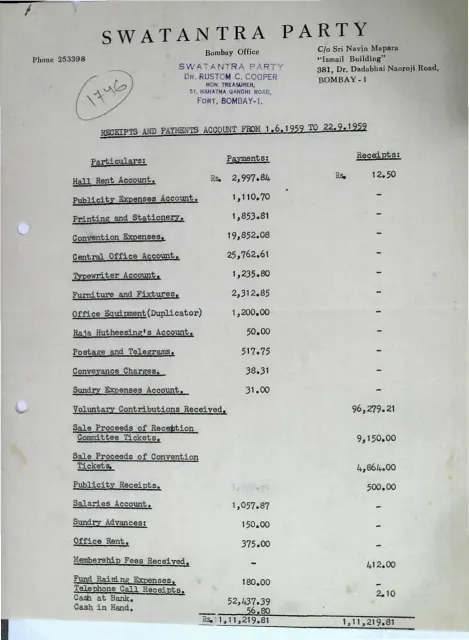 Primary workRECEIPTS AND PAYMENTS ACCOUNT FROM 1.6.1959 TO 22.9.1959
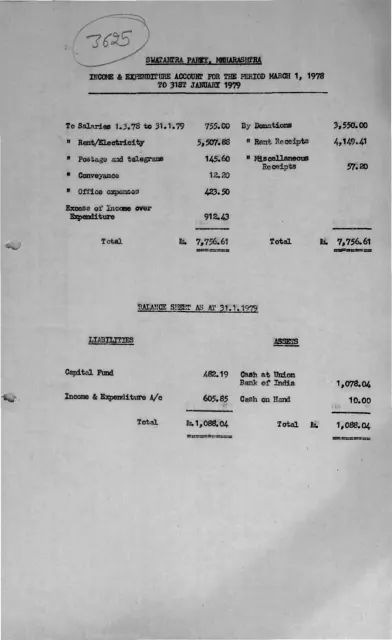 Primary workINCOME & EXPENDITURE ACCOUNT FOR THE PERIOD MARCH 1, 1978 TO 31ST JANUARY 1979
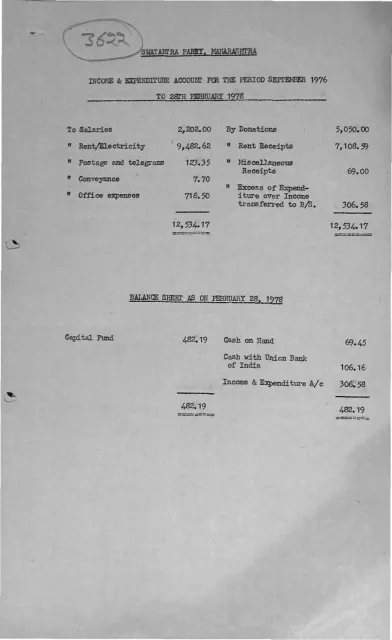 Primary workINCOME & EXPENDITURE ACCOUNT FOR THE PERIOD SEPTEMBER 1976 TO 28TH FEBRUARY 1978
 ExcerptFifteen Years of Indian Planning
 Thinkerb-r-shenoy