speech · convention address
The Outlook for Party Politics in India
By Minoo Masani
Printed by Shyam Pannal for the North Bombay Junior Chamber, C/o. Godrej Soaps Pvt. Ltd., Eastern Express Highway, Vikhroli, Bombay 79 and printed by him at Inland Printers, 55 Ganvadi Road, Bombay - 7. · Bombay · 1968
15 pages
Summary
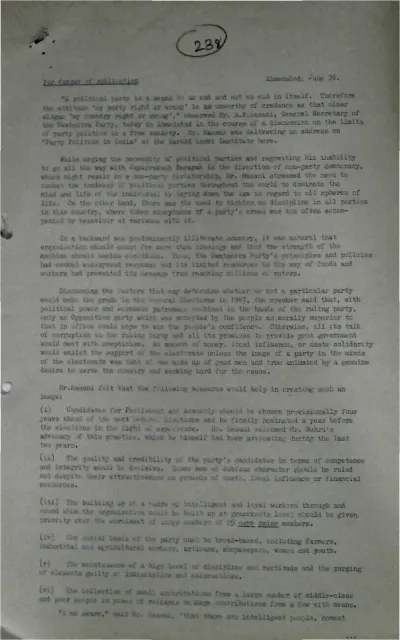
In this speech, delivered to the North Bombay Junior Chamber on 21 June 1968, M. R. Masani examines the condition and prospects of party politics in India. He begins by arguing that political parties, despite their defects, are indispensable to democracy: they help identify representative candidates and provide the organised opposition necessary for constitutional government. He rejects both partyless democracy and the elevation of parties into ends in themselves, insisting that parties are instruments for representing citizens and pursuing limited public objectives.
Key points
- Masani argues that political parties are necessary for representative government because they help identify candidates and organise opposition.
- He criticises party domination of individual conscience while maintaining that a party is a means to an end rather than an end in itself.
- He attributes India’s weak party system to illiteracy, caste, personality-based patronage, money power, inadequate democratic roots, and the absence of internal party discipline.
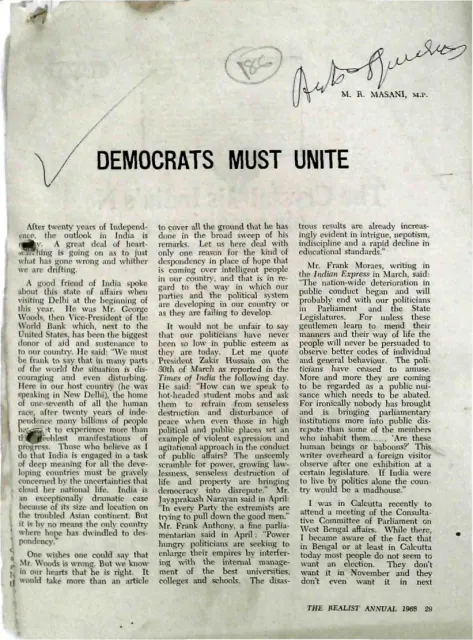
- He describes public disenchantment with politicians in India and abroad, citing electoral instability, defections, corruption, and declining confidence in parliamentary institutions.
- He links political decay to economic controls, licensing, planning, and the concentration of economic and political power.
- He calls for civic participation, political education, leadership training, ethical discipline, and voluntary action at the grassroots.
- He advocates cooperation among anti-communist and anti-communalist parties, while warning that democratic renewal cannot be achieved merely by changing the constitutional form of government.
Metadata and summary are AI-extracted from the source PDF and reviewed for editorial accuracy. The original work is available via the Read PDF tab above (where present); paragraph-level citation inside the PDF is deferred to a future engagement.