Summary
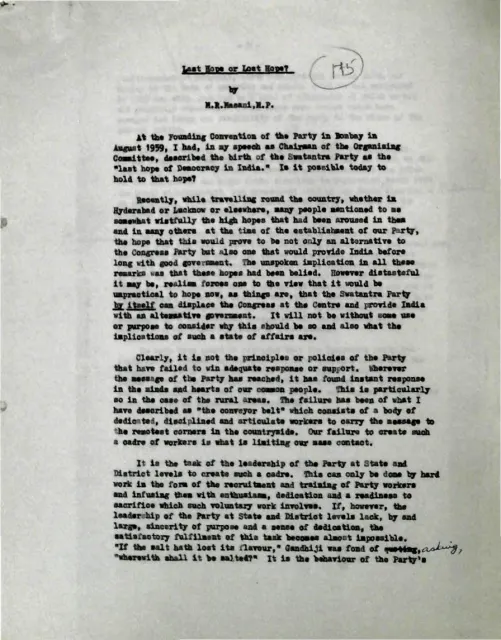
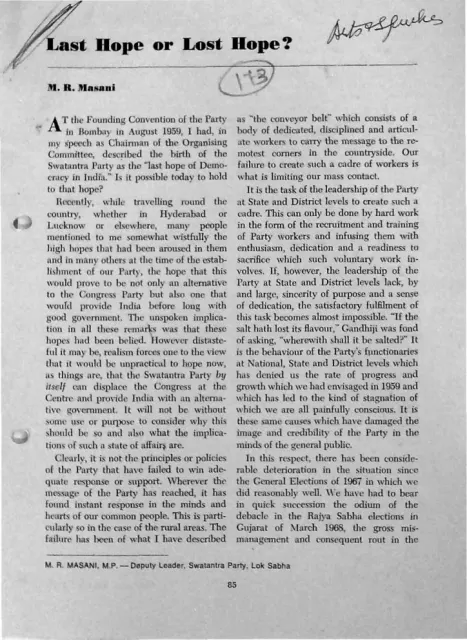
In this two-page essay, M. R. Masani revisits his 1959 description of the Swatantra Party as the “last hope of Democracy in India” and asks whether that hope remains realistic. He argues that the party’s failure to win adequate public support does not arise primarily from its principles or policies, but from its weak organisation, insufficient outreach to rural areas, and inability to build a disciplined cadre capable of carrying its message beyond the cities. The party’s disappointing electoral record—including setbacks in the 1967 general elections, the 1968 Rajya Sabha elections in Gujarat, the Dausa by-election, and the Haryana Assembly elections—is presented as evidence of organisational and managerial failure rather than ideological failure.
Masani calls for a change in the party leadership’s attitude and methods. He stresses recruitment, training, dedication, ethical discipline, sincerity of purpose, and a renewed willingness to serve. The essay concludes with an appeal to ordinary party members to examine honestly whether they still have faith in the Swatantra Party and whether they are acting worthily of the cause of freedom. The visible excerpt is complete across the two rendered pages, though it is presented as an excerpt within the 1968 Swatantra Souvenir and no wider table of contents is available.
Key points
- Masani recalls his 1959 characterization of the Swatantra Party as the last hope of Indian democracy.
- He attributes the party’s lack of public support chiefly to organisational weakness rather than defective principles or policies.
- The party has failed to create a disciplined rural cadre able to communicate its message across India.
- Electoral reverses in 1967 and 1968 are cited as evidence of poor leadership, management, and party functioning.
- Masani recommends systematic recruitment and training, greater dedication, ethical discipline, and a renewed sense of purpose.
- He asks both party leaders and ordinary members to examine whether they genuinely retain faith in the party and its cause of freedom.
Metadata and summary are AI-extracted from the source PDF and reviewed for editorial accuracy. The original work is available via the Read PDF tab above (where present); paragraph-level citation inside the PDF is deferred to a future engagement.