Summary
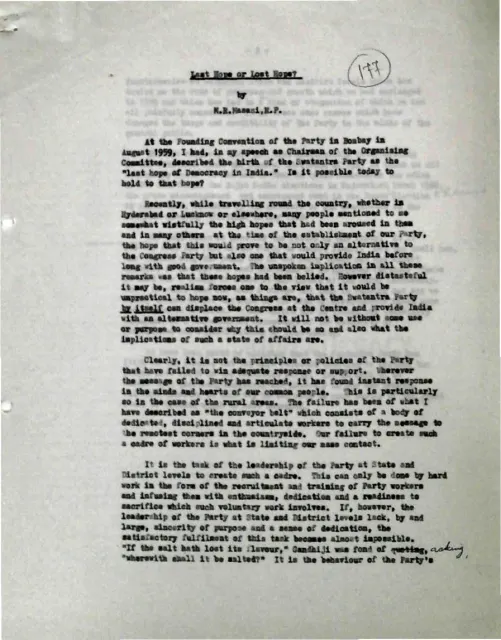
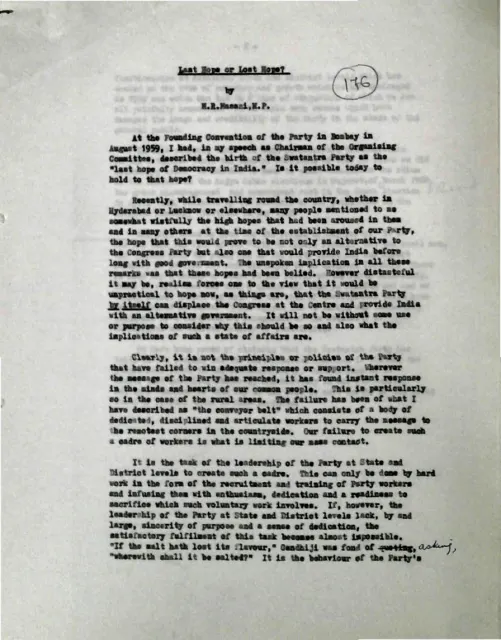
In the rendered pages, M. R. Masani reflects on the gap between the Swatantra Party’s early promise and its disappointing political performance. Recalling the party’s founding convention in Bombay in August 1959, he argues that public hopes for an alternative to the Congress Party have been frustrated by electoral defeats and by the party’s failure to establish itself as a credible national governing alternative.
In the rendered pages, Masani locates the problem less in the party’s principles than in its organisation and leadership. He calls for renewed recruitment and training of workers, especially in rural areas, and urges the rank and file, younger members, and ordinary workers to demand a change in the party’s leadership and methods. The essay closes by asking members to decide honestly whether the Swatantra Party still merits the people’s faith and whether they can better serve the cause of freedom.
Key points
- Masani recalls the Swatantra Party’s founding in 1959 and the hope that it would provide a national alternative to Congress.
- He attributes the party’s failure primarily to weak organisation, leadership, and worker mobilisation rather than to its principles.
- The party’s inadequate presence in rural areas is identified as a major organisational weakness.
- Masani cites electoral setbacks in Gujarat and Haryana as evidence of deteriorating public credibility.
- He calls for systematic recruitment and training of party workers at national, state, and district levels.
- He urges ordinary members and younger workers to speak out and press for changes in leadership and functioning.
- The essay frames the party’s future as dependent on recovering public faith in its commitment to freedom.
Metadata and summary are AI-extracted from the source PDF and reviewed for editorial accuracy. The original work is available via the Read PDF tab above (where present); paragraph-level citation inside the PDF is deferred to a future engagement.