Summary
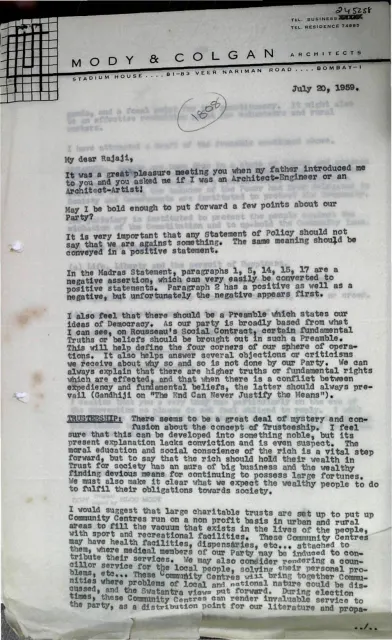
In this letter dated July 20, 1959, Piloo Mody writes to C. Rajagopalachari (“Rajaji”) with proposed revisions to the emerging Swatantra Party’s policy. Mody argues that party statements should express positive commitments rather than merely opposition, and recommends a preamble grounded in democracy, popular sovereignty, constitutional government, fundamental rights, and the rule of law. Drawing on Rousseau’s Social Contract and Gandhi’s observation that “the End Can Never Justify the Means,” he proposes that expediency must yield to fundamental beliefs when the two conflict.
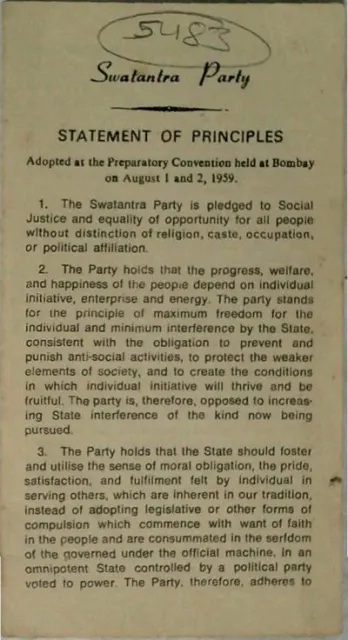
Mody then addresses the concept of trusteeship, calling for a clearer account of the obligations of wealthy people to society. He suggests that large charitable trusts establish non-profit community centres providing health, educational, sports, recreational, and local civic services. The attached draft preamble and fifteen policy principles combine civil and property rights with social welfare: they endorse equality of opportunity, basic-needs provision, productive enterprise, self-employed peasant agriculture, limits on collectivisation and state enterprise, restrained taxation, opposition to inflationary finance, restoration of constitutional guarantees, and a state limited largely to essential functions. The document is complete as rendered, although its title is not printed and some page folios are unclear.
Key points
- Mody urges the Swatantra Party to formulate positive policy commitments rather than define itself chiefly through opposition.
- The proposed preamble grounds government in popular sovereignty, constitutional protection, judicial responsibility, and fundamental rights.
- The letter calls for a clearer and more practical doctrine of trusteeship, including social obligations for wealthy citizens.
- Mody proposes non-profit community centres offering health, education, recreation, and civic services in urban and rural areas.
- The policy draft supports equality of opportunity, freedom of choice and movement, due process, and protection against constitutional violations.
- Its economic programme favours self-employed peasant proprietors, private initiative, restrained taxation, limited state enterprise, and protection of property and employment rights.
- The draft rejects coercive collectivisation, excessive bureaucracy, deficit financing beyond repayment capacity, and policies producing rapid inflation.
Metadata and summary are AI-extracted from the source PDF and reviewed for editorial accuracy. The original work is available via the Read PDF tab above (where present); paragraph-level citation inside the PDF is deferred to a future engagement.