essay
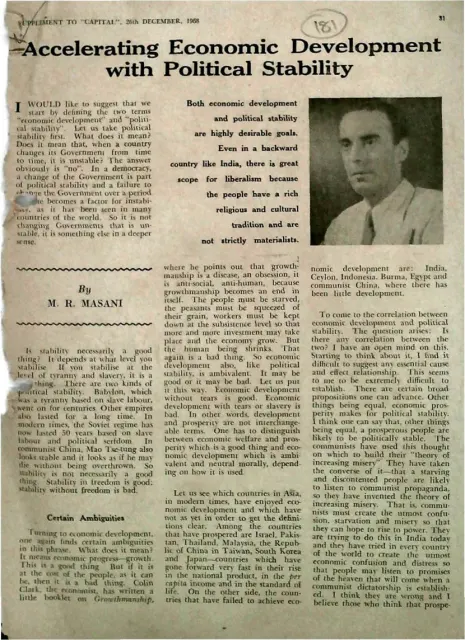
Accelerating Economic Development with Political Stability
By Minoo Masani
SUPPLEMENT TO "CAPITAL", 26th DECEMBER, 1968 · 1968
6 pages
Summary
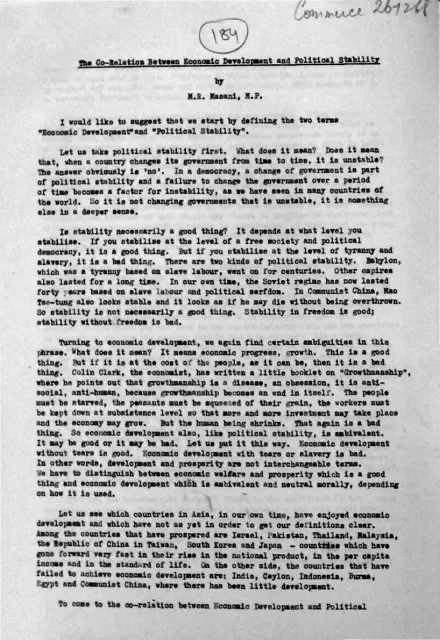
In this essay, M. R. Masani argues that economic development and political stability are both desirable but should not be treated as identical or automatically connected. He distinguishes stable government from mere continuity in office, and political stability from authoritarian order. Economic development, likewise, can mean growth, but growth pursued as an end in itself may become what Colin Clark calls “growthmanship.” Masani insists that prosperity and stability are morally and politically valuable only when associated with freedom, social welfare, and a competitive economy rather than slavery, coercion, or scarcity.
Masani surveys Asian examples and argues that economic and non-economic factors—including religion, culture, caste, communal conflict, language, personality, and political institutions—produce a mixed relationship between development and stability. He rejects the communist claim that poverty is necessary for revolution and criticises the use of misery as a political instrument. The essay concludes by defending liberalism as a tradition rooted both in Western thinkers and in Mahatma Gandhi’s indigenous liberalism. It calls for free enterprise, peasant property rights, limited government, political freedom, and a liberalism closely connected to ordinary people, especially India’s rural population.
Key points
- Political stability is not the same as an unchanged government, authoritarian rule, or the suppression of political freedom.
- Economic development should not be reduced to growthmanship; growth becomes harmful when treated as an end in itself.
- Economic development can be compatible with both political stability and instability, depending on how prosperity is distributed and used.
- Non-economic forces—including religion, culture, caste, communal tensions, language, personality, and education—shape political stability.
- Masani disputes the communist argument that poverty and misery are prerequisites for revolution.
- The essay defends competitive free enterprise, peasant proprietorship, and a state that supplies infrastructure while acting as an impartial umpire.
- Indian liberalism is presented as drawing on both Western liberal thinkers and Gandhi’s indigenous liberal tradition.
- Masani argues that liberalism must speak to peasants and the illiterate poor if it is to preserve India’s freedom and pursue development.
Metadata and summary are AI-extracted from the source PDF and reviewed for editorial accuracy. The original work is available via the Read PDF tab above (where present); paragraph-level citation inside the PDF is deferred to a future engagement.